

The ISO Microchip Mistake That Could Cost You Your Pet at the Airport
Imagine this. Do Microchips Work Internationally
You’ve booked your flights, reserved pet-friendly accommodations, completed your pet’s health checks, and arrived at the airport ready for your international adventure.
Then a customs officer scans your pet’s microchip.
Nothing happens.
The scanner cannot detect the chip.
Suddenly, your dream trip becomes a stressful nightmare.
Many pet owners don’t realize that not all pet microchips work internationally. In fact, using the wrong microchip could result in denied entry, expensive quarantine periods, delayed travel, or even your pet being sent back home.
If you’re planning to travel abroad with your dog or cat, understanding international microchip requirements is essential.
This guide explains everything you need to know about international pet microchips, ISO standards, travel regulations, and how to ensure your pet can safely cross borders.
Table of Contents
- Do Microchips Work Internationally?
- What Is an ISO Microchip?
- Why International Travel Requires ISO-Compliant Microchips
- Countries That Require ISO Pet Microchips
- What Happens If Your Pet Has a Non-ISO Chip?
- How Airports Verify Pet Microchips
- When Should You Microchip Your Pet Before Travel?
- International Pet Travel Checklist
- Common Pet Travel Microchip Mistakes
- FAQs
- Final Thoughts
Do Microchips Work Internationally?
The Short Answer: Yes—But Only If They Meet International Standards
Many pet owners ask:
“Do microchips work internationally?”
The answer is yes, but only if the microchip complies with international ISO standards.
A pet microchip acts as a permanent identification system. It links your pet to vaccination records, ownership documents, import permits, and health certificates.
However, if customs officials cannot read the chip, they cannot verify your pet’s identity.
Without verification, your pet may face:
- Travel delays
- Additional inspections
- Mandatory quarantine
- Entry refusal
- Return transportation costs
For international travel, the correct microchip matters just as much as your pet’s passport and vaccination records.
What Is a Pet Microchip?
A pet microchip is a tiny electronic device approximately the size of a grain of rice.
Veterinarians implant the chip beneath your pet’s skin, typically between the shoulder blades.
The chip contains a unique identification number that can be read by a scanner.
Unlike GPS trackers, microchips:
Do not track location
Do not use batteries
Do not transmit signals
Provide permanent identification
Link pets to owner information
Remain functional for years
To learn more about microchip lifespan, read:
Related Article:
https://savethislifenow.com/how-long-does-a-pet-microchip-last/
What Is an ISO Microchip?
Understanding ISO 11784 and ISO 11785 Standards
An ISO-compliant microchip follows international standards established by the International Organization for Standardization (ISO).
These chips:
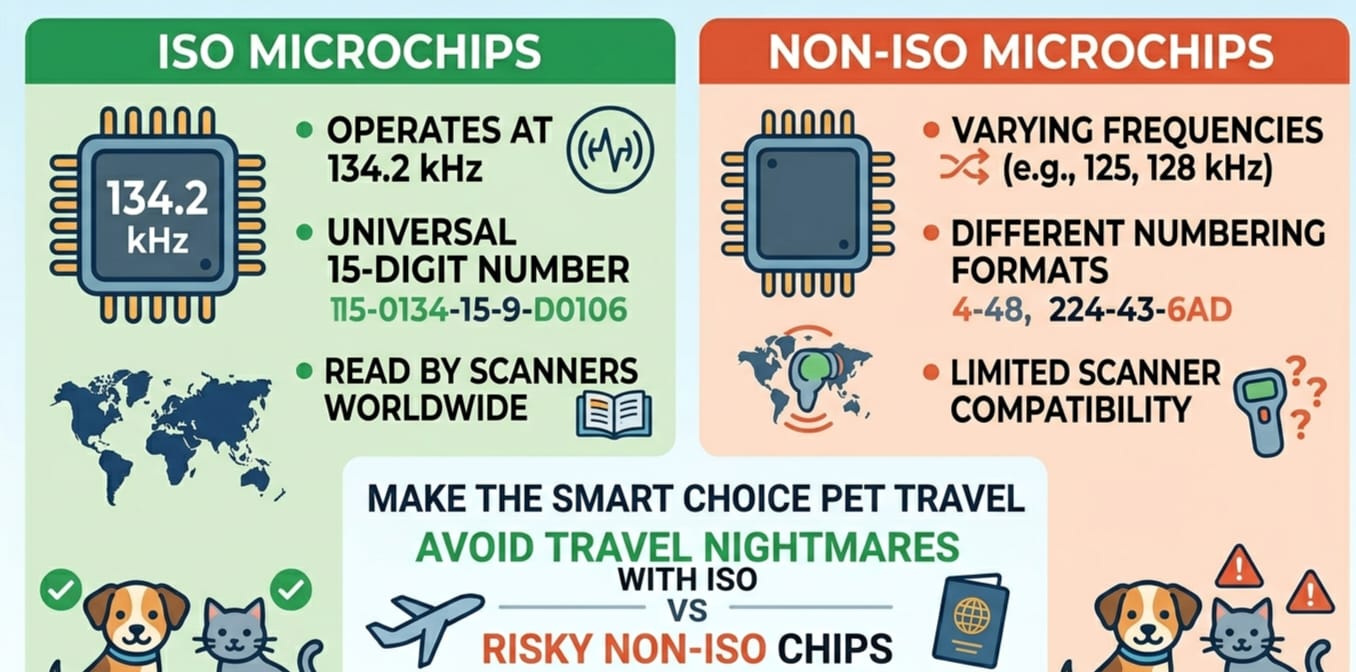
- Operate at 134.2 kHz
- Use a universal 15-digit identification number
- Can be read by scanners worldwide
Because ISO chips use a globally recognized standard, airports, customs agencies, veterinarians, and animal quarantine facilities can identify pets consistently.
This universal compatibility makes ISO microchips the preferred standard for international pet travel.
Why International Travel Requires ISO-Compliant Microchips
International pet travel depends on one critical factor:
Identity Verification
Government agencies must confirm that:
- The pet entering the country matches official documents.
- Rabies vaccinations belong to the correct pet.
- Health certificates are accurate.
- Import permits are valid.
The microchip number serves as the permanent identifier connecting all these records.
Without an ISO-compliant microchip, authorities may not be able to verify your pet’s identity.
The Difference Between ISO and Non-ISO Microchips
ISO Microchips
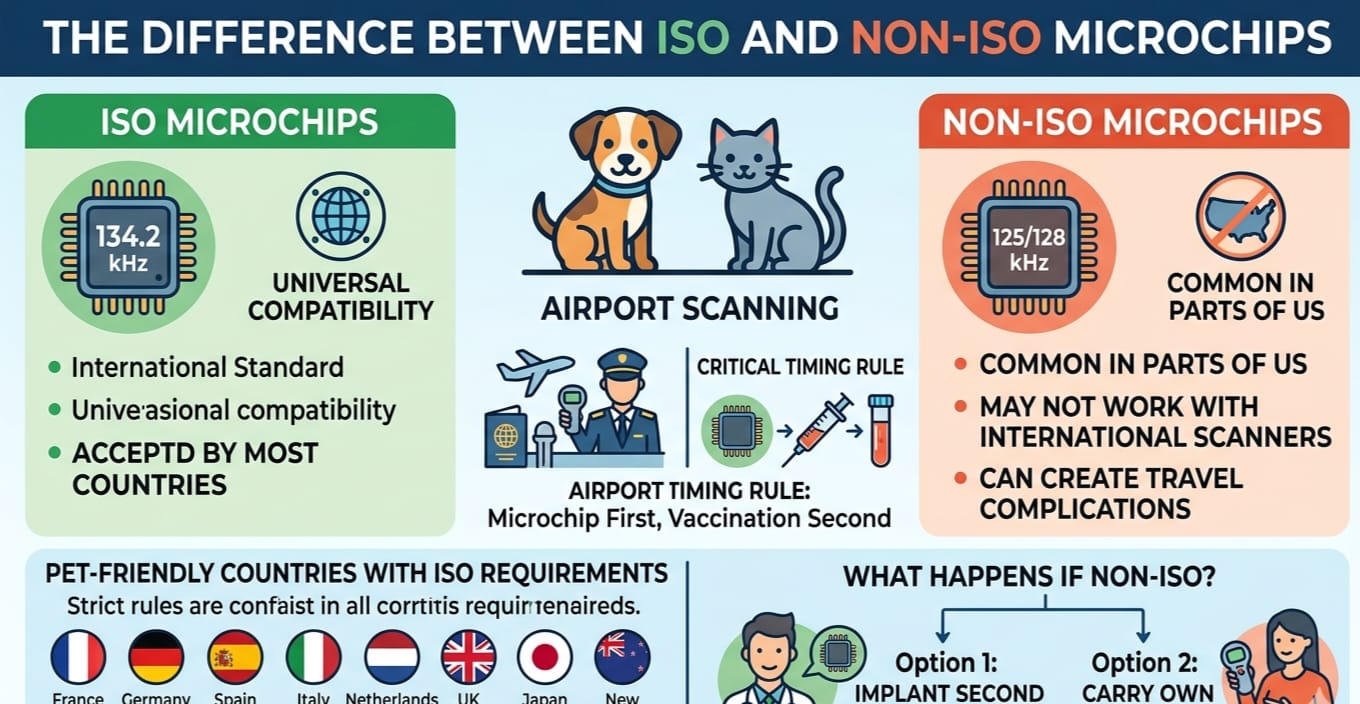
- Frequency: 134.2 kHz
- Universal compatibility
- Accepted by most countries
- International standard
Non-ISO Microchips
- Usually 125 or 128 kHz
- Common in some parts of the United States
- May not work with international scanners
- Can create travel complications
Many pet owners discover this difference only after arriving at the airport.
Unfortunately, by then it may be too late.
Countries That Require ISO-Compliant Microchips
Many countries require ISO-standard microchips before entry.
Examples include:
Europe
- France
- Germany
- Spain
- Italy
- Netherlands
United Kingdom
The UK requires:
- ISO-compliant microchip
- Rabies vaccination
- Approved health documentation
Australia
Australia has some of the world’s strictest pet import requirements.
Microchips must:
- Be ISO compliant
- Be implanted before vaccinations
- Match all import documentation
Japan
Japan also requires:
- ISO microchips
- Rabies vaccination
- Rabies antibody testing
- Strict waiting periods
New Zealand
New Zealand mandates:
- ISO-compliant microchips
- Veterinary certification
- Import permit compliance
What Happens If Your Pet Has a Non-ISO Microchip?
Many pet owners discover their pet already has a non-ISO chip.
Fortunately, you still have options.
Option 1: Implant a Second ISO Microchip
Many veterinarians recommend adding a second ISO-compliant microchip.
Benefits:
- Maintains existing identification
- Meets international requirements
- Avoids scanner compatibility issues
Option 2: Carry Your Own Scanner
Some countries allow owners to provide a compatible scanner.
However, this option is risky because customs officials may refuse entry if they cannot independently verify the chip.
Most travel experts recommend adding an ISO-compliant chip.
How Airports Check Pet Microchips
Many travelers are surprised by how often their pet’s microchip is checked.
Before Departure
Veterinarians scan the microchip before issuing health certificates.
Airline Check-In
Some airlines verify:
- Microchip number
- Travel documents
- Vaccination records
Customs Inspection
Upon arrival, officials often:
- Scan the pet
- Verify identification
- Match documents
This final checkpoint determines whether your pet meets entry requirements.
The Critical Timing Rule Most Pet Owners Miss
One of the most common international travel mistakes involves vaccination timing.
Microchip First, Vaccination Second
Many countries require:
- Microchip implantation
- Rabies vaccination
- Blood testing (if required)
- Health certification
If your pet receives a rabies vaccine before being microchipped, the vaccine may be considered invalid for international travel.
This mistake can delay travel by weeks or even months.
International Pet Travel Checklist
Before traveling internationally with your pet:
Verify Microchip Type
Ensure the chip is ISO 11784/11785 compliant.
Confirm Registration
Make sure your contact details are current.
Update Contact Information
Recently moved?
Read:
How to Update Microchip Information When You Move
https://savethislifenow.com/update-microchip-information-when-you-move
Verify Rabies Records
Ensure vaccinations are linked to the microchip number.
Schedule Veterinary Examination
Obtain all required certificates.
Review Destination Requirements
Every country has unique rules.
Common International Pet Travel Mistakes
Waiting Until the Last Minute
Some countries require preparation months in advance.
Assuming All Microchips Are Global
Not all chips work internationally.
Forgetting Registration Updates
A registered microchip is just as important as implantation.
Using Incorrect Documentation
Every document must match the microchip number exactly.
Ignoring Country-Specific Rules
Requirements vary significantly between destinations.
Why Microchip Registration Matters During International Travel
A microchip alone is not enough.
The chip number must connect to accurate owner information.
Update:
- Phone number
- Address
- Email address
- Emergency contacts
If you’re unsure what to do after implantation, read:
Related Article:
https://savethislifenow.com/what-to-do-after-your-pet-is-microchipped/
Frequently Asked Questions
Do microchips work internationally?
Yes. ISO-compliant microchips are recognized worldwide and are required by many countries.
Can I travel internationally with a non-ISO microchip?
Some destinations may allow it, but many require ISO-compliant chips. Adding a second ISO chip is often recommended.
What is an ISO pet microchip?
An ISO microchip follows ISO 11784 and ISO 11785 standards and operates at 134.2 kHz.
Does a microchip track my pet’s location?
No. Microchips provide identification only and do not function as GPS devices.
How long does a pet microchip last?
Most microchips are designed to function for your pet’s entire lifetime.
What happens if customs cannot read my pet’s microchip?
Your pet may face:
- Entry delays
- Additional inspections
- Quarantine
- Entry refusal
Final Thoughts
So, do microchips work internationally?
Absolutely—but only if your pet has an ISO-compliant microchip that meets international travel requirements.
A simple microchip issue can lead to denied boarding, lengthy quarantines, or even separation from your pet. That’s why verifying your pet’s microchip before international travel is one of the most important steps in travel preparation.
Whether you’re relocating overseas, taking a vacation, or moving abroad permanently, ensuring your pet has the correct microchip can save you thousands of dollars, countless headaches, and potentially keep your beloved companion by your side throughout the journey.
Before your next international trip, confirm your pet’s microchip type, registration status, and travel documents. That small chip could be the difference between a smooth arrival and a travel disaster.
