
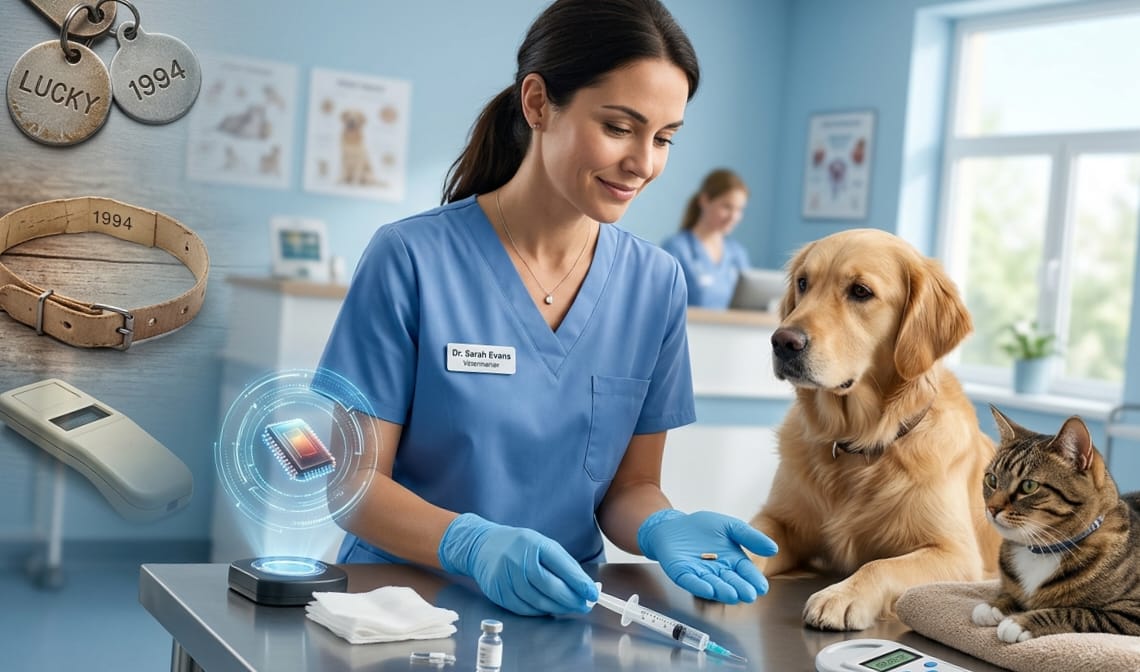
Every year, millions of dogs and cats slip out of open gates, snap their leashes, or bolt during a thunderstorm. Before a tiny device the size of a grain of rice existed, a lost pet’s chances of finding its way home came down to luck, a paper collar tag, or a stranger’s kindness. The history of pet microchipping is really the story of how technology closed that gap — turning “lost forever” into “reunited by dinnertime.”
If you’ve ever wondered when pet microchipping started, how it evolved, and why shelters and veterinarians now treat it as standard care, this guide walks through the full timeline. And if you haven’t yet chipped your own pet, our pet microchipping guide explains exactly what to expect at the appointment.
What Is a Microchip, Exactly?
Before diving into the history, it helps to know what the technology actually is. A microchip is a small, passive electronic transponder — it has no battery and does not track location in real time. It sits inert under a pet’s skin until a scanner passes over it, at which point it emits a unique identification number. That number is matched to an owner’s contact details in a pet recovery database.
This is a common point of confusion, so it’s worth repeating: a microchip is not a GPS tracker. For real-time location tracking, owners need a separate GPS collar. Microchips exist for one purpose — permanent, tamper-proof identification. Our article on microchips vs. GPS trackers breaks down the difference in more detail.
The Origins: Tracking Wildlife Before Pets (1980s)
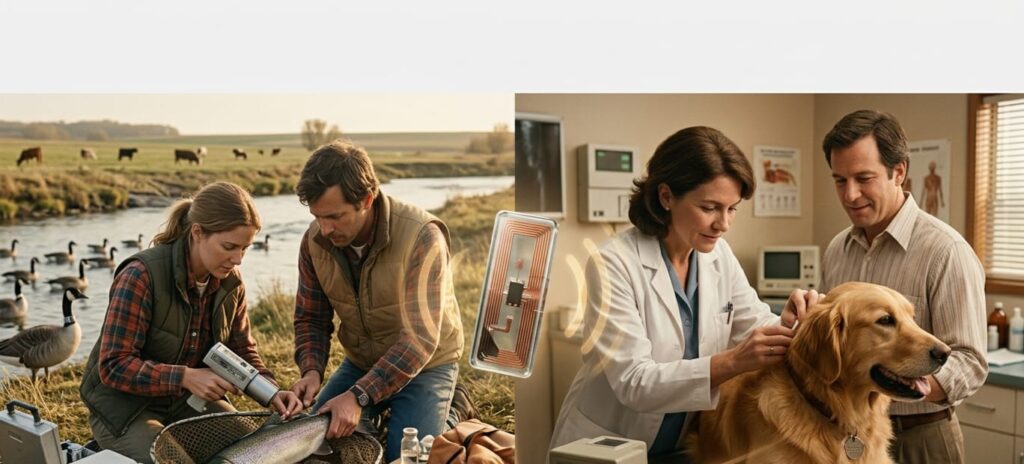
The technology behind pet microchips didn’t start with pets at all. It began in wildlife biology and agriculture.
In the early 1980s, researchers were looking for a better way to track fish, birds, and livestock than traditional tagging methods, which were bulky, visible, and prone to falling off or being removed. The answer was PIT tags — Passive Integrated Transponders. These tiny implantable chips let scientists identify individual animals in migration studies without disturbing their natural behavior. By the mid-1980s, PIT tags were already being used to monitor fish populations and track livestock on farms.
This agricultural and research use proved the concept: a small implanted chip could carry a permanent ID without a battery, without maintenance, and without falling off. It was only a matter of time before someone applied that same idea to companion animals.
The First Pet Microchips (Late 1980s)
Pet microchipping as we know it emerged in the late 1980s, largely as an extension of livestock identification technology. Veterinarians and animal welfare organizations recognized the same core problem in companion animals that farmers faced with cattle: collars and tags could be removed, damaged, or lost, but an animal’s identity needed to be permanent.
By 1989, microchip technology had been introduced for companion animals in parts of Europe, with the United States following closely behind. Early adopters were mostly research facilities, breeders, and forward-thinking veterinary clinics — the general pet-owning public wouldn’t catch on for another decade or more.
The Growing Pains of Early Standardization (1990s)
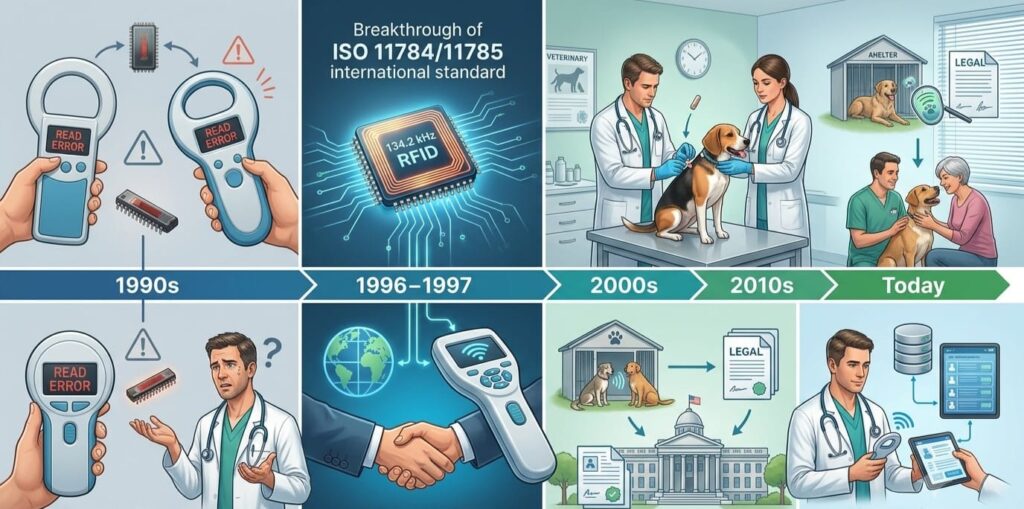
The 1990s were the awkward teenage years of microchip technology. Multiple manufacturers created their own chip frequencies and proprietary scanners, which meant a chip from one company often couldn’t be read by a scanner from another. A pet chipped with Brand A’s device might go completely undetected by a shelter using Brand B’s scanner — defeating the entire purpose of the technology.
This fragmentation pushed veterinary groups, animal charities, and electronics manufacturers to collaborate on a shared standard. Committees formed throughout the decade to standardize chip frequency, implantation location (the area between the shoulder blades became the universal standard site), and database registration practices.
That collaborative effort culminated in the ISO 11784/11785 standard, finalized internationally in 1996 and adopted widely by 1997. This standard set a universal 134.2 kHz frequency for microchips, meaning a compliant scanner could now read a compliant chip regardless of manufacturer. It was the single biggest turning point in the technology’s history — the moment microchipping went from a patchwork of incompatible gadgets to a reliable global system.
Microchipping Goes Mainstream (2000s)
With a universal standard in place, adoption accelerated through the 2000s. Animal shelters began microchipping every intake animal as standard procedure. Veterinary associations started recommending microchipping alongside vaccinations during routine visits. National pet recovery databases expanded, making it possible for a chip registered in one state (or country) to be identified almost anywhere.
Public awareness grew too, often driven by high-profile stories of pets reunited with owners years after going missing — sometimes after traveling hundreds of miles. These stories did more to popularize microchipping than any marketing campaign could have. If you want to see how modern reunification actually works step by step, check out our guide on what happens when a lost pet is scanned.
Microchipping Becomes Law (2010s)
As evidence mounted that microchipped pets were reunited with owners at dramatically higher rates than pets with only collars and tags, some governments moved from recommending microchipping to requiring it.
The United Kingdom’s Microchipping of Dogs Act 2015 made chip implantation and registration mandatory for all dogs in England, a policy later expanded to include cats as well. Similar mandates have appeared in various countries and municipalities worldwide, reflecting a broader shift: microchipping was no longer viewed as an optional extra but as a baseline standard of responsible pet ownership.
Where the Technology Stands Today
Modern microchips are smaller, more reliable, and more universally readable than ever. Nearly all shelters, animal control agencies, and veterinary clinics now carry universal scanners capable of reading ISO-standard chips regardless of brand. Some newer chips even include additional data fields, and researchers continue exploring biometric and temperature-sensing chip technology for future generations.
Despite decades of progress, the technology’s core promise hasn’t changed since its earliest days: a simple, permanent, tamper-proof way to answer the question “Whose pet is this?” To understand how today’s chips compare with older models, see our breakdown of microchip technology generations.
Why This History Still Matters for Your Pet
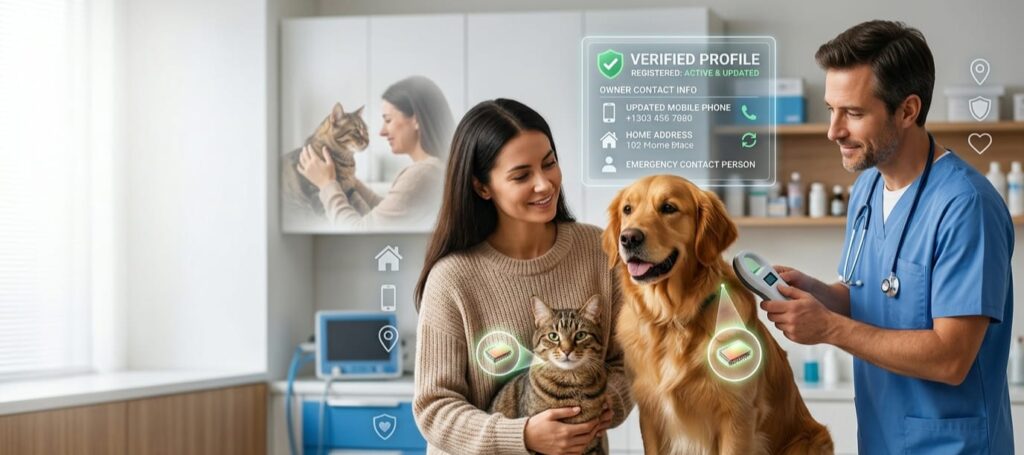
Understanding the history of pet microchipping isn’t just trivia — it explains why the system works the way it does today, and why keeping your registration current matters so much. The entire infrastructure was built specifically to solve the problem of permanent, universally readable identification. A chip is only as useful as the contact information attached to it, which is why we always recommend owners double-check their registration details after moving or changing phone numbers. Our microchip registration checklist walks through exactly what to update and when.
If your pet isn’t chipped yet, or you’re not sure whether your existing chip is registered correctly, don’t wait for an emergency to find out. Visit our pet microchipping guide to learn what the procedure involves, or explore our full library of lost pet prevention resources to keep your companion safe for good.
Frequently Asked Questions
When did pet microchipping start? The core technology emerged from livestock and wildlife tracking in the early 1980s, with the first microchips used specifically in companion animals appearing in the late 1980s, around 1989.
When did microchipping become standardized? The ISO 11784/11785 international standard was finalized in the mid-1990s and widely adopted by 1997, allowing universal scanners to read chips from any compliant manufacturer.
Is microchipping legally required? In some countries, yes. The UK, for example, made dog microchipping mandatory under the Microchipping of Dogs Act 2015, later extended to cats. Requirements vary by country and region.
Does a microchip track my pet’s location? No. A microchip only stores an ID number that links to your contact information — it has no GPS function and cannot be tracked in real time.
Ready to protect your pet the modern way? Explore more on savethislifenow.com — from pet microchipping costs to our complete

What Is a Microchip, Exactly?
Before diving into the history, it helps to know what the technology actually is. A microchip is a small, passive electronic transponder — it has no battery and does not track location in real time. It sits inert under a pet’s skin until a scanner passes over it, at which point it emits a unique identification number. That number is matched to an owner’s contact details in a pet recovery database.
This is a common point of confusion, so it’s worth repeating: a microchip is not a GPS tracker. For real-time location tracking, owners need a separate GPS collar. Microchips exist for one purpose — permanent, tamper-proof identification. Our article on microchips vs. GPS trackers breaks down the difference in more detail.