

The Question Every Dog Owner Asks — And Almost Everyone Gets Wrong
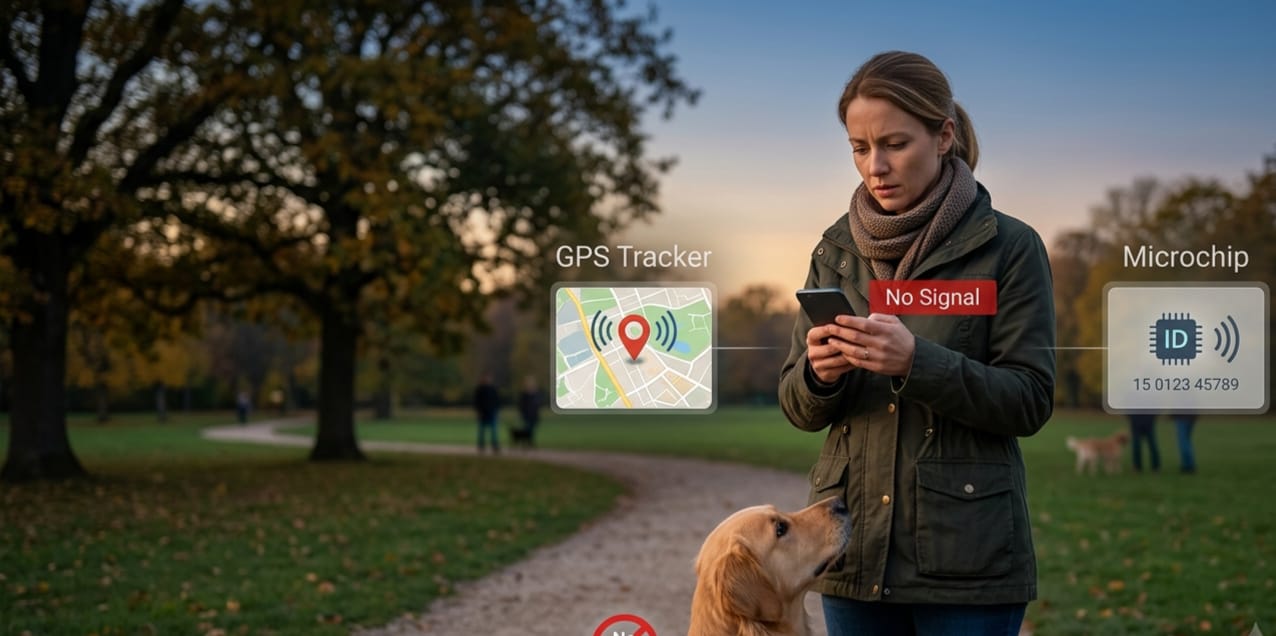
You just had your dog microchipped. Or maybe you’re thinking about it. Either way, a very natural thought crosses your mind:
“Great — so now I can track my dog if she gets lost, right?”
Wrong. And this misunderstanding isn’t just a minor technicality. It is one of the most dangerous myths in pet safety — because millions of dog owners believe they are protected by their dog’s microchip when, in a genuine emergency, they are not.
The answer to “Can you track a dog with a microchip?” is a clear, firm, science-backed no.
A microchip cannot track your dog’s location. It cannot tell you where your dog is. It cannot send an alert when your dog leaves your yard. It has no GPS. It has no signal. It does not broadcast anything until a vet or shelter worker physically holds a scanner inches from your dog’s body.
And yet, study after study shows that the vast majority of pet owners don’t know this. SafeWise research found that most pet owners aren’t aware there is a difference between microchips and GPS trackers — potentially dangerous misinformation affecting millions of dogs across the U.S.
This article gives you the complete picture. We’ll break down exactly what a microchip does and does not do, why implantable GPS is impossible with current technology, what the real myths are (and where they come from), and what actually works to track your dog in real time when it matters most.
Is your dog’s microchip registered and up to date? That’s step one. Check your dog’s status right now: Free Microchip Lookup Tool — SaveThisLifeNow.com
What a Dog Microchip Actually Is (And What It Isn’t)
Before busting the myths, let’s establish exactly what a dog microchip is — because the confusion starts here.
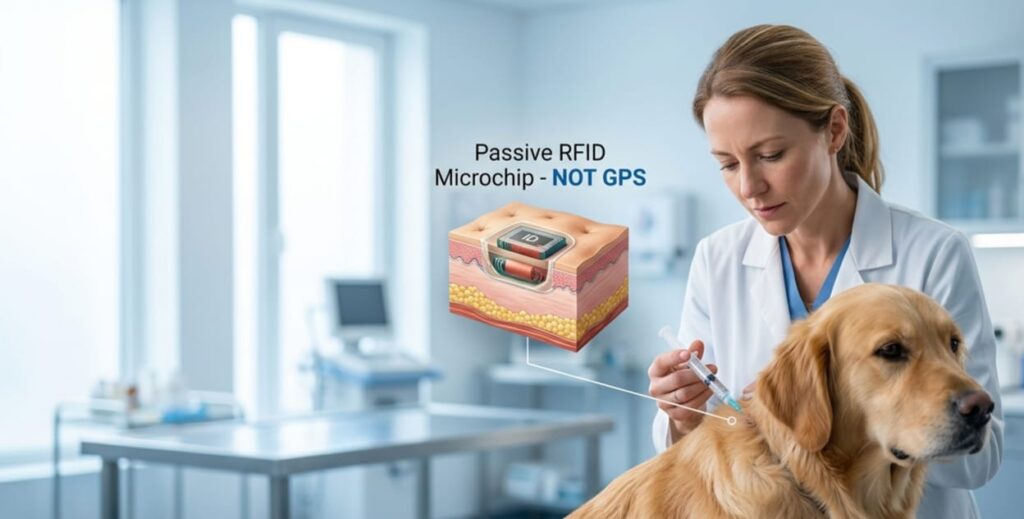
A dog microchip is a passive RFID transponder — Radio Frequency Identification. It is a tiny electronic chip enclosed in a biocompatible glass cylinder, approximately 11–14 mm long and 2–2.3 mm in diameter. About the size of a grain of rice. It weighs roughly 0.025 grams.
The chip is implanted under your dog’s skin, usually between the shoulder blades, via a needle slightly larger than those used for standard vaccinations. The procedure takes seconds and causes momentary discomfort similar to a vaccine shot.
Here is what the chip contains: one unique ID number. That is all. Nothing else.
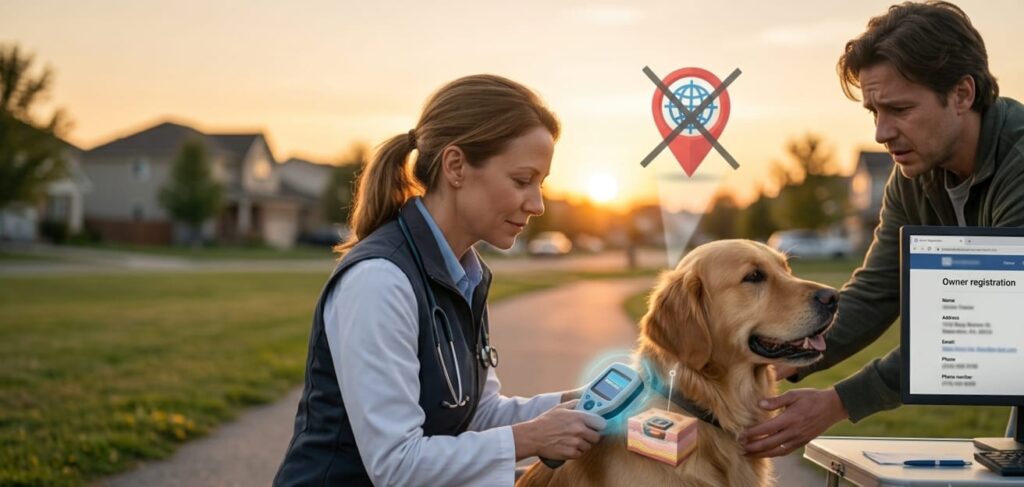
Here is what happens when the chip is scanned: a microchip scanner emits a low-power radio frequency. The chip’s coil antenna absorbs that energy, powers the chip momentarily, and transmits the ID number back to the scanner. The scanner displays the number. A vet or shelter worker then enters that number into a registry — like AKC Reunite or HomeAgain — to find your contact information.
Notice what is entirely absent from this process:
- No GPS satellite signal
- No cellular network transmission
- No battery or power source inside the chip
- No active broadcasting of any kind
- No location data, ever
The microchip is passive. It does absolutely nothing unless a scanner is held within a few centimeters of it. It is, essentially, a barcode tattooed under your dog’s skin — incredibly useful for permanent identification, completely useless for real-time tracking.
Learn more: How Does a Pet Microchip Actually Work? — SaveThisLifeNow.com
Myth #1: “My Dog’s Microchip Has GPS — I Can Track Her If She Gets Lost”
VERDICT: 100% FALSE
This is the most widespread and most dangerous myth in pet microchipping. It is the belief that a microchip functions like a GPS tracker — that when your dog goes missing, you can open an app, see her location on a map, and go get her.
This belief is false. Completely, categorically, technically false.
A microchip for dogs is a radio-frequency identification (RFID) implant. As the name makes clear, it is used for identification purposes only. It provides a permanent and safe solution for identifying your dog. That is its entire function.
Can you track a dog with a microchip in real time? No. Not even partially. The chip transmits a number — and only a number — and only when a scanner is physically touching the dog. There is no GPS coordinate. There is no map. There is no app. There is no signal leaving your dog’s body on its own.
Where this myth comes from: The confusion largely stems from marketing language and the conflation of two separate technologies. When people hear “chip” and “tracking” in the same sentence — whether in news stories about recovered pets or in casual conversation — the brain fills in the gap with GPS logic it already understands from smartphones and apps. The microchip IS how a lost dog gets identified after being found — but “identified” and “tracked” are not the same thing.
Myth #2: “There Is a GPS Microchip for Dogs You Can Implant”
VERDICT: DOES NOT EXIST IN 2025 — HERE’S THE SCIENCE
This myth goes a step further. Not just that the current microchip has GPS — but that there exists, somewhere, an implantable GPS chip you can put under your dog’s skin to track them.
It doesn’t exist. As of 2025, a GPS implant chip for dogs remains science fiction. Here is exactly why, from first principles:
The Physics Problem: GPS Signals Cannot Penetrate Body Tissue
GPS receivers work by detecting signals from satellites orbiting the Earth. Those signals arrive as extremely high-frequency radio waves. The fundamental problem is that GPS signals cannot pass through skin, muscle, and fat tissue. The body blocks and absorbs the signal entirely.
Telemetry Solutions, a company that manufactures GPS implants for wildlife research on animals like snakes, has confirmed this directly: GPS signals will not penetrate into the body. Even their “implants” designed for wild animals require the antenna to physically exit through the skin. The transmitting element must be external to the body to work.
An implanted GPS chip inside a dog’s body would receive no satellite signal. It would be completely blind — and therefore useless.
The Hardware Problem: Impossibly Small Requirements
A functional GPS tracker requires multiple hardware components working together:
- A GPS antenna (to receive satellite signals)
- A GPS processing chip (to calculate position from signal data)
- A GSM/cellular module (to transmit that location to your phone)
- A battery (to power all of the above)
- Supporting circuits and protective housing
Even the world’s smallest commercially available GPS chips measure around 4.5mm × 4.5mm. That’s just the chip — not the antenna, battery, or cellular module. A complete functional GPS tracker, built as compact as modern engineering currently allows, is orders of magnitude larger than the grain-of-rice microchip currently implanted in dogs.
GPS implants for dogs do not exist and are not a safe or healthy option due to the large size of necessary hardware components — GPS antenna, GSM module, and battery pack. These components require physical space and ventilation that is not possible in a safe subcutaneous implant.
The Battery Problem: No Way to Charge an Implant
Even if the size problem were solved, an implanted GPS device would need power. Batteries drain. Even the longest-lasting GPS trackers on the market today last only about a week before needing a recharge. An implanted battery cannot be recharged without a surgical procedure. It also cannot safely be replaced without repeated surgeries. And a battery sealed inside a dog’s body creates heat, potential toxicity risks, and long-term safety concerns that no veterinary organization would approve.
Current technology cannot design an extremely small but high-capacity battery. Even if such a battery were implanted, how would it be charged or replaced without causing repeated harm to the dog?
The Fraud Warning
Because this product sounds so appealing, it has attracted scammers. One company, Escape Alert LLC, filed patents and issued press releases claiming to have developed an implantable GPS chip powered by a piezoelectric nanogenerator. Their Kickstarter never launched. The product never existed. The CEO was later convicted on fraud charges.
As of 2025: if anyone claims to sell an implantable GPS microchip for dogs, it is a scam. Multiple patents exist on paper describing the concept. None has resulted in a working product. Filing a patent is not the same as solving the physics.
Related: Best GPS Trackers for Dogs in 2025 — SaveThisLifeNow.com
Myth #3: “If My Dog Is Lost, Her Microchip Will Help Find Her Right Away”
VERDICT: PARTIALLY TRUE — BUT ONLY UNDER SPECIFIC CONDITIONS
This myth is more nuanced. A microchip can help recover your dog — but “help” is doing a lot of heavy lifting in that sentence, and the conditions required are more limiting than most owners realize.
For a microchip to help recover your lost dog, all of the following must be true:
- A person must physically find your dog
- That person must take your dog to a vet, shelter, or facility with a microchip scanner
- The scanner must be compatible with your chip’s frequency
- Your chip must be registered in a national database
- That database must be searchable through the AAHA Universal Lookup Tool
- Your contact information in that database must be current and reachable
Every single one of these conditions is a potential failure point. Your dog being found is not guaranteed. Good Samaritans don’t always know to take strays to shelters. Chip frequencies aren’t always universal. Registration is often forgotten (only about 60% of microchipped pets are registered). And outdated phone numbers and addresses cause reunions to fail every single day.
This is why microchipping advocates always say: the chip only works after someone finds your dog and brings them somewhere. It is a passive, reactive technology. It does nothing to prevent your dog from getting lost. It does nothing in the hours after your dog runs away. And it does nothing at midnight when your dog is wandering alone in the dark.
Don’t let this happen to you: How to Update Your Dog Microchip Contact Information for Free — SaveThisLifeNow.com
Myth #4: “GPS Trackers and Microchips Do the Same Thing”
VERDICT: COMPLETELY FALSE — THEY DO OPPOSITE THINGS
This myth runs in the opposite direction of Myth #1. Some owners who DO know the difference between microchips and GPS trackers incorrectly assume they’re interchangeable — that one replaces the other.
They don’t. They serve entirely different purposes. Understanding this difference is foundational to building a real pet safety system.
| Feature | Dog Microchip | GPS Dog Tracker |
|---|---|---|
| Primary Purpose | Permanent identification | Real-time location tracking |
| How It Works | Passive RFID — scanned by reader | Active GPS + cellular signal |
| Power Source | None — completely passive | Battery (requires regular charging) |
| Size | Grain of rice — implanted | Collar attachment — worn externally |
| Real-Time Tracking | Never | Yes, live on your phone |
| Works When Dog Is Lost | Only after someone finds and scans them | From the moment they escape |
| Works If Collar Is Lost | Always — permanent under skin | No — device must be worn |
| Requires Subscription | No | Most do (cellular network cost) |
| Upfront Cost | $25–$75 one-time | $50–$250 device |
| Ongoing Cost | $0–$25 registration | $5–$15/month subscription |
| Best For | Permanent ID, proof of ownership | Active tracking, escape prevention |
A microchip provides identification, not location data. It cannot help you find your lost pet unless the pet is taken to a vet or shelter to have their chip scanned. GPS tracking provides real-time location monitoring using satellite networks where you can stay connected with your pet via an app on your smartphone.
These two tools are not competitors. They are complementary layers of protection that together cover what neither can do alone.
Myth #5: “Apple AirTags Work Like GPS Trackers for Dogs”
VERDICT: MISLEADING — SERIOUS LIMITATIONS IN PET TRACKING
AirTags have become popular as budget alternatives to dedicated GPS dog trackers. They’re cheap (~$29), widely available, and smartphone-integrated. But using an AirTag to track a lost dog comes with serious limitations that most buyers don’t research before purchasing.
AirTags use Bluetooth crowdsourcing — not GPS. They work by detecting nearby Apple devices in the “Find My” network and piggybacking on those devices to report location back to you. The range for direct Bluetooth connection is only 30–100 feet. In rural areas, parks, or anywhere with sparse Apple device density, AirTags become largely useless.
Consider: your dog escapes at night in a suburban neighborhood. If nobody walks past your dog with an iPhone in their pocket, the AirTag reports nothing. Meanwhile, a GPS tracker using cellular networks would have been pinging your phone with live coordinates from the moment your dog bolted.
AirTags: proximity-based tracking via Bluetooth, suitable for short-range. GPS trackers: real-time location updates over long distances. For lost pet tracking in emergencies, Bluetooth crowdsourcing falls critically short compared to cellular GPS.
See our full comparison: GPS Tracker vs AirTag for Dogs: Which Actually Works? — SaveThisLifeNow.com
Now that we’ve cleared the myths, here is what actually works — the tools that genuinely let you answer “where is my dog?” in real time.
So What CAN Actually Track Your Dog in Real Time?
Option 1: Cellular GPS Dog Trackers (Best for Most Owners)
These are collar-attached devices that use GPS satellites to determine your dog’s location and a cellular (LTE/4G) network to transmit that location to your phone via an app. They work anywhere there is cell service.
How they work: The tracker uses GPS to detect its own (and therefore your dog’s) location. It sends live coordinate data through the mobile network to an app on your phone. You see a moving dot on a map. You know exactly where your dog is.
Key features most cellular GPS trackers offer:
- Live tracking — real-time location on a map, updated every few seconds
- Geofencing (safe zones) — set a virtual boundary and receive an instant alert the moment your dog leaves it
- Escape alerts — automatic notification when your dog starts moving outside the defined zone
- Activity and health monitoring — step counting, sleep tracking, and behavior pattern data
- Historical route tracking — see where your dog went after the fact
Popular cellular GPS trackers in 2025:
- Tractive GPS — one of the most widely used globally; $50 device + $5–$13/month subscription; real-time tracking with unlimited range
- Fi Series 3 — strong build quality, long battery life, LTE-M network coverage; subscription required
- PitPat — UK-focused but expanding; strong activity monitoring
The trade-off: Cellular GPS trackers depend on cell tower coverage. In rural areas, dense forests, mountain trails, or any location without LTE signal, performance degrades. For urban and suburban dog owners, this rarely matters. For dogs on wilderness hikes, it’s a real limitation.
Option 2: Radio-Frequency GPS Trackers (Best for Rural Areas and Off-Grid)
These devices use GPS to locate the dog and transmit that position directly to a handheld controller via radio signal — with no phone, no app, and no cell tower required.
Best options in 2025:
- Aorkuler GPS Dog Tracker — $249.99 with no subscription; GPS to handheld controller via radio; range up to 3.5 miles in open terrain; ideal for farms, forests, and rural properties
- Garmin Alpha Series — $800+; professional-grade multi-dog tracking used by hunters; long range and rugged construction; the gold standard for off-grid tracking
These work in places cellular trackers don’t — remote farms, national forests, mountains, and anywhere without cell service. The trade-off is higher upfront cost and a handheld controller instead of a smartphone app.
Option 3: GPS + Microchip (The Complete Safety System)
The smartest, most comprehensive approach combines both technologies rather than choosing between them.
- The microchip handles the worst case: Your dog loses her collar. She’s found by a stranger three days later. The chip provides permanent, undeniable identification. It brings her home even without the GPS tracker.
- The GPS tracker handles the common case: Your dog bolts through the gate. You open the app. You see exactly where she is. You go get her in 10 minutes, before she ever reaches a shelter.
The GPS tracker handles the common scenario. The microchip handles the worst case. Together, they cover both.
The bottom line: A pet owner’s first line of defense against a missing pet is GPS tracking. A microchip is valuable for identification after your dog goes missing — but a GPS tracker can prevent that from happening to begin with.
Build your full pet safety system: Complete Dog Safety Checklist: Microchip, GPS, and ID Tags — SaveThisLifeNow.com
Will GPS Microchip Implants Ever Exist?
This is a fair question for the tech-curious. The honest answer: maybe someday — but not soon, and not easily.
Research projects like SnapperGPS (Oxford University, weighing 0.9 grams, using snapshot-based GPS logging) and experimental kinetic energy harvesters tested on dogs show that miniaturization is genuinely progressing. But these are data loggers — they store location data that gets downloaded later when the device is physically recovered. They are not real-time trackers. They would not alert you when your dog escapes. They would tell you where she went after you already found her.
Real-time implantable GPS tracking for dogs is, conservatively, a decade or more away — if it is ever possible at all. The physics of GPS signal propagation through body tissue, the antenna design requirements, and the challenge of implantable power sources combine into a problem that no current research roadmap has a credible solution for.
For now, and for the foreseeable future: the microchip is your dog’s permanent ID, and the GPS tracker is your real-time tracking tool. They are different devices. They do different things. You should have both.
The Complete Myth vs. Reality Summary
| Myth | Reality |
|---|---|
| “My dog’s microchip has GPS” | Microchips are passive RFID — no GPS, no tracking, ever |
| “I can track my dog with her chip” | You cannot track a dog with a microchip — only identify her after she’s found |
| “GPS implants for dogs exist” | No implantable GPS exists or is near development — GPS can’t penetrate body tissue |
| “AirTags work as well as GPS trackers” | AirTags use Bluetooth crowdsourcing, not GPS — unreliable for lost dog tracking |
| “GPS and microchips do the same job” | They do opposite jobs — ID vs. live tracking — and you need both |
| “A microchip will protect my dog if she runs” | A chip only helps after she’s physically found and brought to a scanner |
Frequently Asked Questions
Can you track a dog with a microchip in real time?
No. A dog microchip cannot track your dog’s real-time location under any circumstances. It is a passive RFID device that stores only a unique ID number. It transmits nothing unless physically scanned by a reader. Real-time tracking requires a GPS device worn on the collar.
Is there a GPS chip that can be implanted in a dog?
No. As of 2025, no implantable GPS device for dogs exists anywhere in the world. GPS signals cannot penetrate body tissue, and the hardware required for GPS tracking is far too large and power-hungry to be safely implanted. Any company claiming to sell such a product is running a scam.
What does a dog microchip actually do?
A dog microchip permanently stores a unique ID number linked to your contact information in a national registry. If your dog is lost and brought to a vet or shelter, they scan the chip, find the number, look up your details in the registry, and contact you. It is an identification tool — not a tracking tool.
What is the best way to track a lost dog in real time?
A collar-mounted GPS tracker using cellular networks is the most effective real-time tracking option for most dog owners. Devices like Tractive, Fi, and Aorkuler allow you to see your dog’s location on a map from your phone. For areas without cell coverage, radio-frequency GPS trackers like Garmin Alpha work without cellular infrastructure.
Do I need both a microchip and a GPS tracker?
Yes — and for different reasons. The GPS tracker helps you find your dog the moment she escapes. The microchip ensures she can be identified and returned to you even if she loses her collar, even if the GPS battery dies, and even days or weeks after she goes missing. Neither fully replaces the other.
Can shelters see my GPS location through my dog’s microchip?
No. Shelters cannot see any location data through a microchip because no location data exists. They can only read the ID number and look up contact details in the registry.
Why do so many people think microchips have GPS?
The confusion comes from conflating two separate technologies in everyday language — both are called “chips,” both relate to pet safety, and both involve scanning or tracking language. Marketing copy sometimes blurs the line. The reality is that these are completely different technologies with completely different functions.
See also: Dog Microchip Registration Cost: Hidden Fees Explained — SaveThisLifeNow.com
The Bottom Line: Two Tools, Two Jobs, Both Essential
The question “can you track a dog with a microchip” has a simple, definitive answer: no.
A microchip is a grain-of-rice-sized RFID chip with no battery, no GPS, no cellular radio, and no tracking capability of any kind. It is a permanent ID — one of the best forms of permanent identification ever developed for pets. But it cannot tell you where your dog is. It cannot tell you where your dog went. And it cannot bring your dog home by itself.
Real-time tracking of a lost dog requires a GPS device worn externally on the collar — one with GPS satellite reception, cellular or radio transmission, and a battery that gets charged regularly.
Here is the responsible, complete approach to dog safety in 2025:
Layer 1 — Microchip: Permanent ID, registered and up to date, in an AAHA-participating database. Costs $25–$75 once. Lasts the life of your dog. Handles worst-case scenarios.
Layer 2 — GPS Tracker: Real-time location on your phone. Geofencing alerts when your dog leaves home. Finds your dog in minutes when she escapes. Handles the common emergency.
Layer 3 — ID Tag on Collar: Visible, immediate contact info for any stranger who finds your dog before a shelter is ever involved.
All three layers cost less than one emergency vet visit. Together, they form the most complete pet safety system available today.
Step one is making sure your microchip is registered. Check your dog right now: Free Microchip Lookup Tool — SaveThisLifeNow.com
Step two is getting a GPS tracker. See which one is right for your dog: Best GPS Trackers for Dogs 2025 — SaveThisLifeNow.com
