

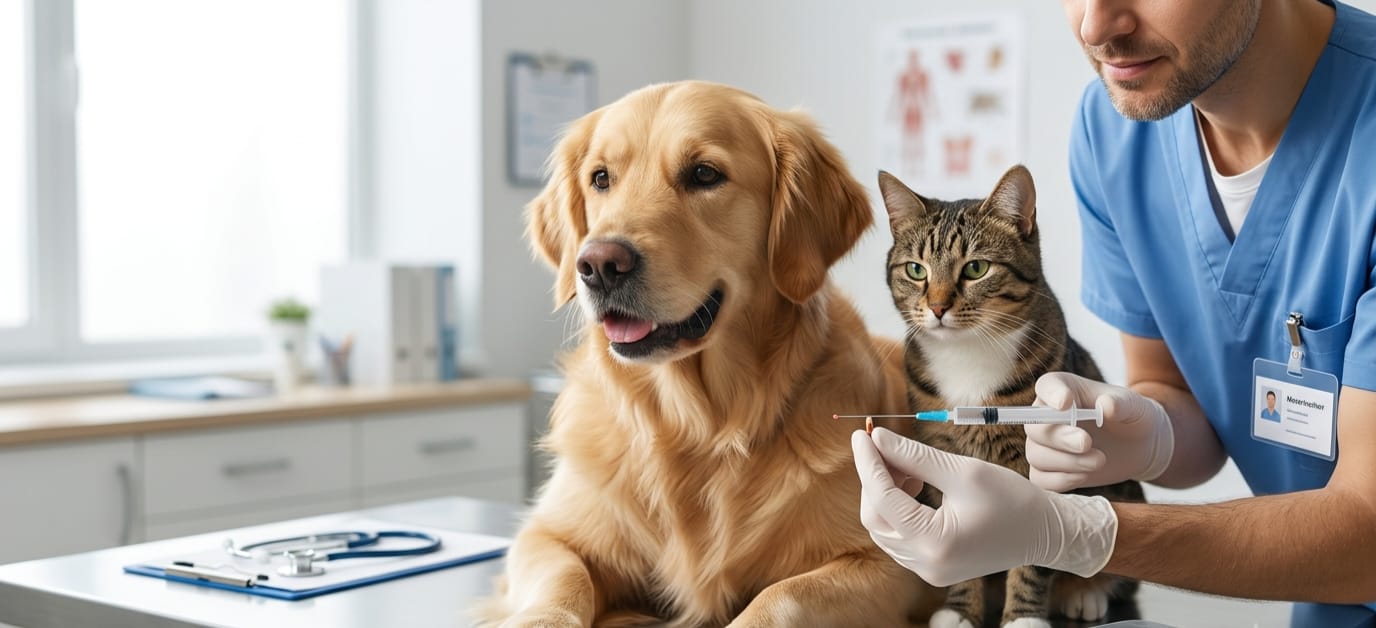
If you’ve spent any time in a pet-owner Facebook group or scrolling through a forum thread at 1 a.m., you’ve probably run into someone insisting that microchips cause cancer in dogs and cats. It’s one of the most persistent pieces of pet-health misinformation out there, and it stops a lot of loving owners from doing something that could bring their pet home if it’s ever lost.
So let’s settle the question with real data instead of anecdotes: are microchips safe for pets? Short answer — yes, overwhelmingly. Here’s the full picture, including where the cancer fear came from, what actual veterinary research says, and how to make an informed decision for your own pet.
What Is a Pet Microchip, Exactly?
A pet microchip is a tiny transponder, roughly the size of a grain of rice, encased in biocompatible glass. A veterinarian injects it under the skin, usually between the shoulder blades, using a needle slightly larger than a standard vaccine needle. There’s no battery and no power source inside — the chip stays completely inert until a scanner passes over it, at which point radio waves trigger it to transmit a unique ID number.
That number is linked to a registry containing your contact information. If your pet ever ends up at a shelter or vet clinic, staff scan for a chip as a matter of routine, pull up your details, and call you. If you’re weighing your options for pet identification, our guide on pet ID tags versus microchips breaks down how the two methods compare side by side.
Where Did the Microchip-Cancer Myth Come From?
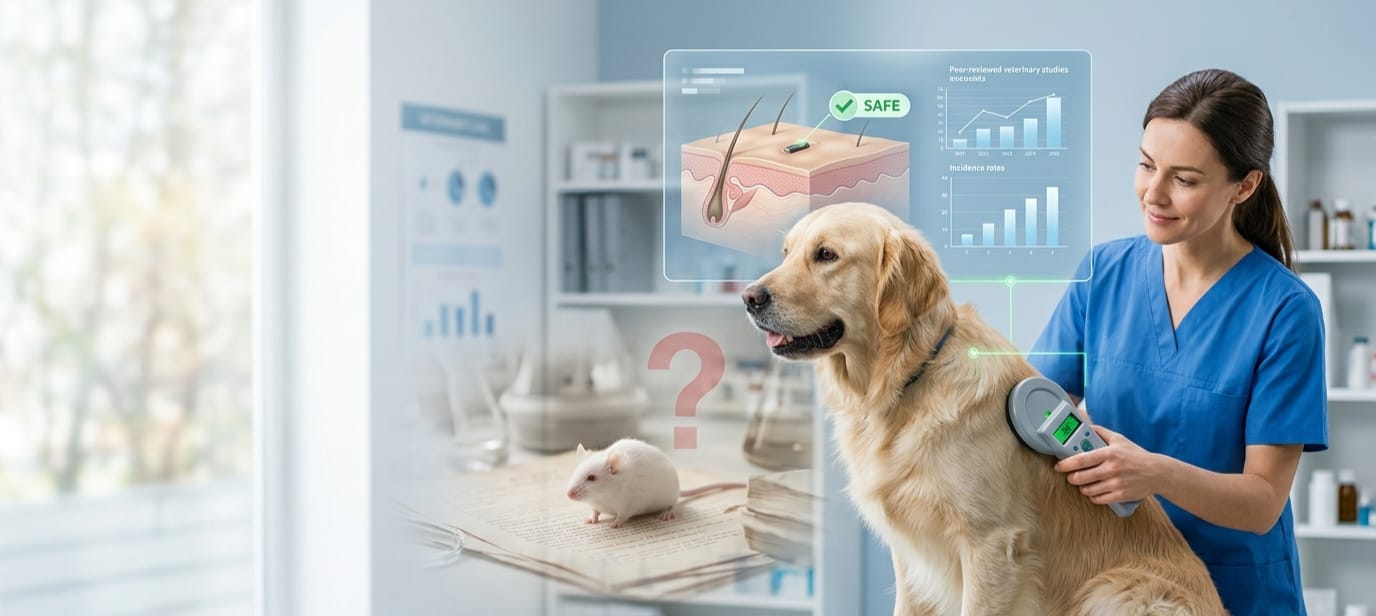
The concern isn’t entirely baseless — it just got wildly overstated. It traces back to a handful of laboratory studies from the 1990s and early 2000s, most notably rodent studies where researchers implanted microchips in lab rats and mice and later found tumors forming near the implant site.
The problem is context. Those rodents were typically strains that are bred specifically because they’re highly prone to spontaneous tumor development, and many were already enrolled in cancer research studies when the tumors were discovered. Extrapolating “a chip caused a tumor in a cancer-prone lab rat” to “your golden retriever is at risk” skips several important steps.
The myth got a second wind in 2007 when an Associated Press investigation revealed that some microchip manufacturers hadn’t flagged these older animal studies to regulators. That story understandably spooked people, and anti-microchipping advocacy groups compiled lists of studies to make the link look stronger than the underlying data actually supports. The narrative has been circulating online ever since, often without the rodent-study context attached.
What Does the Actual Veterinary Data Show?
This is where the numbers matter more than the headlines. The British Small Animal Veterinary Association (BSAVA) has tracked adverse reactions to microchips since 1996. Over that time, more than 4 million animals have been microchipped in the tracked population, and only a few hundred adverse reactions of any kind — including chip migration, infection, or tumor formation — have ever been reported. Tumor formation is the rarest category among those.
Veterinary oncology sources citing the American Veterinary Medical Association note that <cite index=”9-1″>tumors associated with microchips have been reported in only two dogs and two cats, and in at least one dog and one cat the tumor could not be directly linked to the microchip itself and may have had another cause entirely</cite>.
Groups like the World Small Animal Veterinary Association and International Cat Care have reviewed this same body of evidence and reached a consistent conclusion: <cite index=”7-1″>if microchips do contribute to certain cancers in dogs or cats, it appears to be an exceptionally rare event, and the benefits of permanent identification far outweigh that potential risk</cite>.
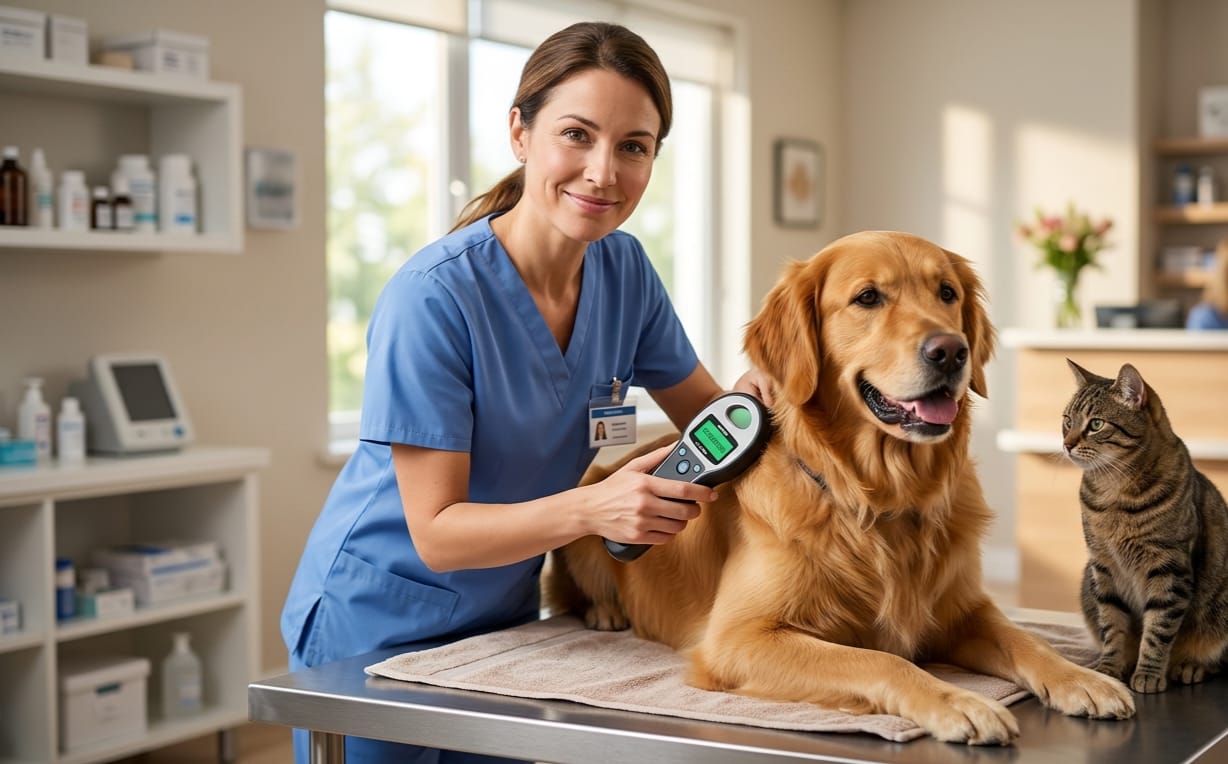
So, Are Microchips Safe for Pets?
Based on two decades of real-world data across millions of animals, the honest answer is yes — with the same asterisk that applies to almost any medical procedure: rare complications exist, but they’re genuinely rare, not common.
Organizations like American Humane have reviewed the same research and echo the AVMA’s position, <cite index=”6-1″>stating that the risk of a pet developing cancer from a microchip is very low and is far outweighed by the improved odds of getting a lost pet back home</cite>.
Benefits of Microchipping
- Permanent ID that can’t fall off, fade, or get removed like a collar tag
- Dramatically higher return-to-owner rates for lost pets — <cite index=”5-1″>AVMA-published research found microchipped dogs were returned to their families at more than double the rate of non-chipped dogs, and microchipped cats were reunited with owners at roughly 20 times the rate of non-chipped cats</cite>
- Quick, low-cost procedure that can be done during a routine vet visit
- Readable anywhere in the world with a compatible universal scanner
- Designed to last your pet’s entire lifetime with no maintenance
Known Risks (Rare but Real)
- Minor, temporary discomfort at the injection site
- Occasional chip migration away from the original implant site
- Very rare infection at the injection site
- Extremely rare tumor formation, as detailed above
If you want to weigh these tradeoffs for your own household, our article on the pros and cons of microchipping your pet goes deeper into each risk factor and how vets minimize them during implantation.
How to Keep Your Pet’s Microchip Working for You
A microchip only works if the information behind it is current. Every year, thousands of microchipped pets end up unclaimed in shelters simply because the registered phone number or address is out of date.
- Register the chip immediately after implantation — don’t leave this step to your vet’s office alone; confirm it yourself
- Update your registry the same week you move or change your phone number
- Mark August 15th, “Check the Chip Day,” on your calendar as an annual reminder to verify your pet’s chip is still reading correctly
- Ask your vet to scan the chip at every annual visit
- Keep a photo of your registry confirmation page somewhere easy to find
For a full walkthrough of registration, see our guide on how to register and update your pet’s microchip.
Frequently Asked Questions
Do microchips cause cancer in dogs? Documented cases are extremely rare. Out of millions of microchipped dogs, only a small handful of tumors have ever been linked to a chip, and even some of those cases had other likely causes.
Do microchips cause cancer in cats? The same holds true for cats — reported cases are exceptionally rare relative to the number of cats microchipped worldwide.
Is it safe to microchip a puppy or kitten? Yes. Microchips can be implanted at nearly any age, and many vets place them during a spay or neuter procedure to combine both under one visit.
What’s actually inside a microchip? Just a passive transponder and an antenna coil sealed in glass — no battery, no GPS, and no way to track your pet’s location in real time.
Should I still microchip my pet given the small risk? Veterinary organizations worldwide, including the AVMA, WSAVA, and International Cat Care, agree that the identification benefits far outweigh the minimal risk.
The Bottom Line
The microchip-cancer story is a classic case of a small, misunderstood signal getting amplified far past what the evidence supports. Rodent lab studies from decades ago don’t translate cleanly to the family dog sleeping on your couch, and the real-world tracking data on millions of microchipped pets backs that up. Microchipping remains one of the simplest, most effective tools for bringing a lost pet home — which is exactly why veterinarians keep recommending it.
Curious what else could help if your pet ever goes missing? Check out our guide to building a complete lost-pet emergency kit for the steps to take before you ever need them.
