
Introduction: Your Dog Is Missing — Here Is Exactly What to Do
Your heart drops. The gate is open. Your dog is gone.
If your dog has a microchip, you already have the most powerful tool available to bring them home. But knowing how to find a lost dog with a microchip means more than just hoping a shelter scans them. It requires fast, specific action — and most pet owners do not know the exact steps.
This guide gives you the complete, step-by-step lost dog recovery process, backed by data from veterinary associations, shelter research, and real microchip recovery cases. Whether your dog just went missing or you want to be prepared before it happens, this is the only recovery guide you need.
What Is a Pet Microchip and How Does It Actually Work?
Before diving into the recovery process, you need to understand what a microchip can — and cannot — do for you.
A microchip is a tiny radio-frequency identification (RFID) device, roughly the size of a grain of rice, implanted just beneath the skin between your dog’s shoulder blades. It contains a unique 9-, 10-, or 15-digit identification number that is linked to your contact details in a microchip registry database.
A microchip is NOT a GPS tracker. It does not show your dog’s real-time location. It cannot be activated remotely. It has no battery and no signal.
Here is how it works in a lost dog scenario:
- Someone finds your dog
- They take the dog to a vet or animal shelter
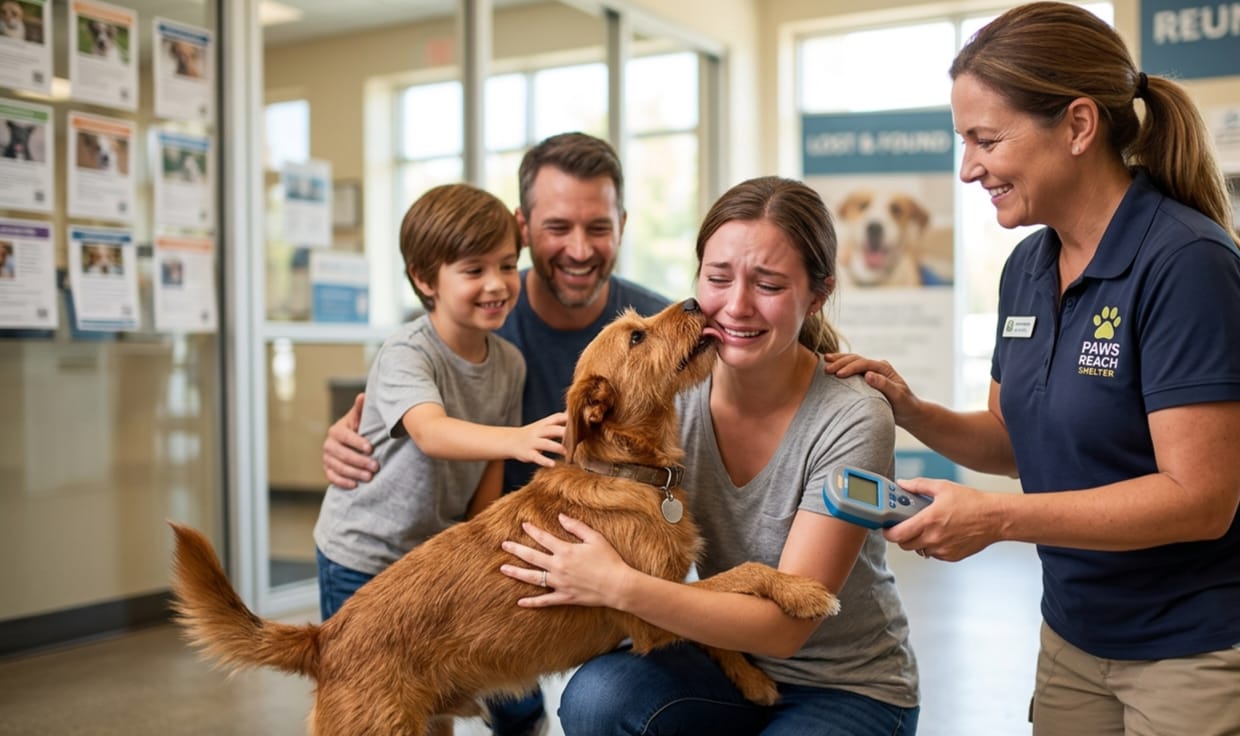
- Staff use a handheld scanner that emits a low radio frequency
- The scanner reads your dog’s unique microchip ID number
- That number is searched in a national registry database
- Your contact information appears — and you get called
The entire system only works if two things are true: the microchip is registered, and your contact information is current. If either condition is missing, the microchip is essentially useless.
Related Guide: How to Register Your Pet’s Microchip — Complete Setup Walkthrough (internal link)
Why a Microchip Dramatically Increases Your Chances of Getting Your Dog Back
The statistics are powerful and should motivate every pet owner to act immediately.
According to the American Veterinary Medical Association (AVMA), lost dogs with microchips are returned to their owners at a rate of 52.2%, compared to just 21.9% for dogs without microchips. That is more than double the return rate.
A landmark study of more than 7,700 stray animals at shelters across 23 U.S. states found that microchipped dogs were returned to their owners at more than double the overall rate for all stray dogs entering shelters.
Additional data from the American Humane Association estimates that over 10 million dogs and cats are lost or stolen in the United States every year. Without any identification, only about 15% of dogs in shelters are ever reunited with their families.
The most heartbreaking finding from the AVMA study: the most common reason microchipped pets were not reunited with their owners was incorrect or disconnected phone numbers in the registry database. The chip worked. The human element failed.
This is why the recovery process starts long before your dog goes missing.
See Also: Pet Microchip Registration Mistakes to Avoid (internal link)
How to Find a Lost Dog With a Microchip: The Exact Step-by-Step Recovery Process
Step 1 — Act Within the First 24 Hours (This Window Is Critical)
The first 24 hours after your dog goes missing are the most important. Most dogs are found close to home — often within a mile — and within the first 24 to 48 hours. Speed matters more than anything else.
The moment you realize your dog is missing, begin the following actions in parallel, not one at a time.
Step 2 — Locate Your Dog’s Microchip Number Immediately
You cannot activate the recovery process without your dog’s microchip number. Find it right now using one of these methods:
- Check the paperwork from the vet or shelter that implanted the chip
- Look in your pet adoption documents
- Check the barcode sticker on the microchip packaging
- Call your vet — they almost certainly have the number on file
- Take your dog to any vet or shelter and have them scan the chip if you no longer have documentation
Write the number down and keep it in your phone. You will need it for every call you make.
Tool: Use Our Free Microchip Lookup Tool to Verify Registration (internal link)
Step 3 — Report Your Dog as Lost With the Microchip Registry
This is the most overlooked step, and it may be the most important.
Contact the microchip registry where your dog is registered and officially report them as missing. When you do this, the registry flags your dog’s chip number in their database. This means if any vet or shelter scans your dog and finds that number, they will immediately receive an alert that this is a reported missing animal — and your contact information will be pushed to them automatically.
Major U.S. microchip registries to contact:
| Registry | Website | Phone |
|---|---|---|
| HomeAgain | homeagain.com | 1-888-466-3242 |
| AKC Reunite | akcreunite.org | 1-800-252-7894 |
| 24PetWatch | 24petwatch.com | 1-866-597-2424 |
| PetLink | petlink.net | 1-877-738-5465 |
| Found Animals | foundanimals.org | Online only |
| AAHA Universal Lookup | petmicrochiplookup.org | Online only |
If you are unsure which registry your dog is in, visit petmicrochiplookup.org and enter the chip number. This universal lookup tool searches across the AAHA national database network and will tell you which registry has your pet’s chip on file.
Important Note for savethislifenow.com Users: If your dog’s microchip number starts with 991 or 900164, it may have been registered through Save This Life. Due to the company’s closure, those registry records are no longer active. Visit our microchip re-registration guide to move your chip to an active registry immediately. (internal link)
Step 4 — Contact Every Local Animal Shelter, Vet, and Animal Control Office
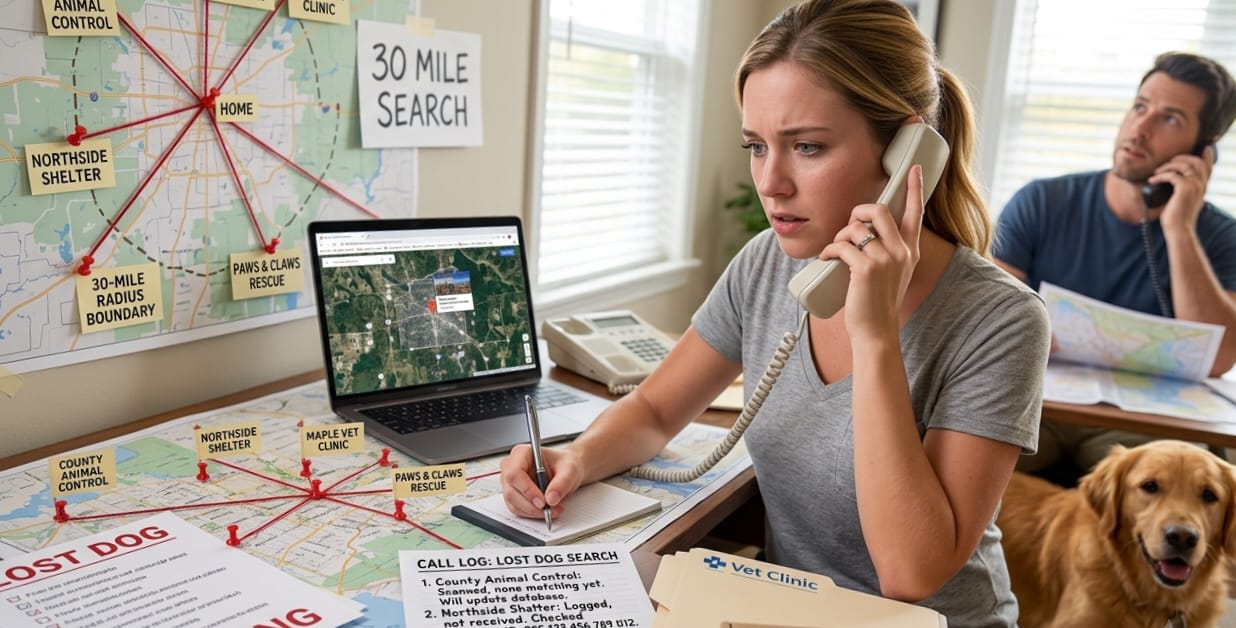
Do not wait for a shelter to call you. Call them first — and call every single one within a 30-mile radius. How to Find a Lost Dog With a Microchip
When you call, provide:
- Your dog’s microchip number
- Your dog’s breed, size, color, and any distinguishing markings
- Your full name and multiple contact numbers
- The date, time, and location your dog was last seen
Ask each shelter to add your dog’s information to their found pet board and to check their intake records going back to when your dog disappeared. Follow up with every shelter every 24 to 48 hours — staff changes and intake volumes mean your initial call may not be enough.
Animal control agencies are equally important. In many cities, animal control officers carry microchip scanners and can scan dogs they encounter in the field — meaning your dog could be identified before ever reaching a shelter.
Related: Which Animal Shelters Use Universal Microchip Scanners? A State-by-State Guide (internal link)
Step 5 — Update Your Contact Information in the Registry Right Now
If there is any chance your phone number, address, or email has changed since you registered the chip — update it immediately, even mid-search. A shelter that finds your dog tonight needs to reach the phone number in the database tonight.
Log in to your microchip registry account and verify:
- Primary phone number (use a cell phone, not a landline)
- Secondary/emergency contact person
- Email address
- Current home address
If you cannot remember your login, call the registry directly. They can verify your identity and update your information over the phone.
Step 6 — Search Your Immediate Neighborhood First
While waiting for shelter callbacks, search your neighborhood systematically. Dogs that are scared, disoriented, or injured often hide nearby rather than traveling far.
Search these hiding spots specifically:
- Under parked cars and in wheel wells
- Behind garden sheds and under decks
- Inside dense bushes or thickets
- Storm drains and culverts
- Open garages or outbuildings in the area
Go out at dawn and dusk when dogs are most active. Bring a familiar item — your dog’s favorite toy, a blanket with your scent, or their empty food bowl. Some lost dogs respond to the sound of their food bag or a familiar squeaky toy.
Step 7 — Flood Social Media and Online Lost Pet Networks
Social media has reunited thousands of lost dogs with their families. Post immediately to:
- Facebook — Your personal profile, local neighborhood groups, and lost/found pet groups
- Nextdoor — Hyper-local neighborhood alerts
- Instagram — Use location tags for your neighborhood and city
- Lost My Doggie (lostmydoggie.com) — Automated community alert system
- Petco Love Lost (petcolove.org/lost) — Photo-matching database for lost and found pets
- Craigslist Lost & Found — Still highly effective for local recovery
Your post should include:
- A clear, recent photo showing your dog’s markings
- Your dog’s breed, color, sex, and approximate size and weight
- The exact street or intersection where they were last seen
- Your microchip number (so anyone who finds your dog can verify ownership)
- Your phone number — a number you will answer at any hour
Ask everyone to share. A single viral post in a local Facebook group can reach 10,000 neighbors within hours.
Step 8 — Put Up Physical Lost Dog Flyers Immediately
Flyers work. Drivers, walkers, mail carriers, and delivery drivers cover huge areas of your neighborhood every day and are often the first people to spot a lost dog.
Make your flyer high-impact:
- Use the largest possible photo — fill most of the page
- Print “LOST DOG” in the largest, boldest font you can
- Include your phone number in a font readable from 10 feet away
- Add your dog’s name, breed, and any very distinctive markings
- Laminate them or use waterproof sleeves — weather destroys paper flyers overnight
Post flyers at:
- Every intersection within a 2-mile radius
- Veterinary offices and pet supply stores
- Dog parks, grooming salons, and doggy daycares
- Grocery store bulletin boards
- Bus stops and community centers
Step 9 — File a Police Report If Theft Is Suspected
If your dog was stolen — taken from your yard, a car, or a public space — file a police report immediately. Provide the officer with your dog’s microchip number. This number serves as legal proof of ownership and is critical if someone else attempts to re-register the chip under a different name.
Contact the microchip registry to flag the chip as stolen. This creates an alert that will notify any vet or shelter that scans the dog.
Related: What to Do If Your Microchipped Dog Is Stolen (internal link)
Step 10 — Enlist Professional Pet Recovery Services
If days have passed without a lead, consider bringing in professional help:
- Professional pet trackers — Organizations with trained search dogs and expanded volunteer networks
- Pet recovery hotlines — Services like HomeAgain and 24PetWatch operate 24/7 recovery specialist teams
- Drone search services — Now available in many major cities; thermal cameras can locate dogs hiding in fields or wooded areas at night
What Happens When a Shelter Scans Your Lost Dog’s Microchip
Understanding the shelter process helps you know why speed on your end matters so much.
When a stray dog is brought into a shelter or veterinary clinic, staff will scan the animal with a microchip reader. The scanner reads the unique ID number. Staff then enter that number into the AAHA Universal Pet Microchip Lookup or contact the registry directly.
If your chip is properly registered and your contact information is current, the shelter contacts you immediately. If your registry has a lost pet alert on file (Step 3), the system may contact you automatically the moment the scan is entered.
However, there are gaps in this process that every pet owner needs to know:
Not all scanners detect all chip frequencies. The U.S. uses microchips that operate at 125 kHz, 128 kHz, and 134.2 kHz. The international ISO standard is 134.2 kHz. Universal (forward-and-backward reading) scanners detect all frequencies, but not every facility has upgraded to these. If your dog’s chip frequency does not match the scanner, the chip may not be detected. This is why it is critical to confirm your dog’s chip is ISO-compliant.
Chips can migrate. In rare cases, a microchip can shift away from the original implant site between the shoulder blades. Shelter staff who know this will scan the dog’s entire body, but not all do. If you believe your dog may have been at a facility and missed, ask them to re-scan thoroughly.
See Also: ISO Microchip Standards Explained — Is Your Dog’s Chip Universal? (internal link)
The Most Common Reasons Microchipped Dogs Are Never Reunited With Their Owners
The chip does not fail. The system fails. Here is why reunions do not happen even when a dog is microchipped:
1. The chip was never registered. Implanting a chip without registering it in a database is exactly like having a blank ID card. Shelters scan the chip, get a number, search it, and find nothing. This is the single biggest failure point.
2. Contact information is outdated. The phone number in the database was disconnected. The owner moved and never updated the address. The email bounces. A registry with a perfect chip number but a wrong phone number cannot reunite you with your dog.
3. The owner never reported the dog as missing. A shelter that scans your dog and finds a valid registration will call you — but if you called the registry proactively and reported your dog missing, the reunion happens faster because the registry is actively looking for matches on their end.
4. The chip is registered with a defunct registry. As seen with the closure of Save This Life, registries can shut down. When they do, the chip data disappears. Always register with large, established registries and check your registration status annually.
5. The registry has incomplete information. Single-contact registrations fail when the primary contact is unavailable. Always add an emergency backup contact — a family member or close friend who can be reached when you are not.
How to Prepare Before Your Dog Ever Goes Missing
The best time to set up your microchip recovery system is today — not after your dog disappears. Here is the preparation checklist every dog owner should complete:
Microchip Setup Checklist
- [ ] Confirm your dog’s microchip number — get it from your vet if you do not have it
- [ ] Verify the chip is registered with a major, active registry
- [ ] Log in to your registry account and confirm all contact information is current
- [ ] Add a secondary emergency contact to your registry profile
- [ ] Add an emergency contact at a different phone number than your own
- [ ] Photograph your microchip documentation and save it in your phone’s camera roll
- [ ] Save the registry’s lost pet reporting phone number in your contacts right now
- [ ] Schedule an annual “Check the Chip” appointment — August 15 is National Check the Chip Day
August 15 is Check the Chip Day. Mark it on your calendar every year. It takes 5 minutes to log into your registry and verify your information — and those 5 minutes could be the difference between losing your dog forever and getting them back.
Complete Guide: The Ultimate Pet Microchip Preparation Checklist for Dog Owners (internal link)
Microchip vs. GPS Collar: Which One Actually Finds Your Lost Dog?
Pet owners often ask whether a microchip is enough or if a GPS collar is also necessary. The honest answer: they do completely different things, and the best-protected dog has both.
| Feature | Microchip | GPS Collar |
|---|---|---|
| Real-time location tracking | No | Yes |
| Works if collar is removed | Yes | No |
| Requires battery or charging | No | Yes |
| Tamper-proof permanent ID | Yes | No |
| Proves legal ownership | Yes | No |
| Works if dog is taken to shelter | Yes | Only if still wearing it |
| Cost | $25–$75 one-time | $30–$150+ per year |
| Works if dog is found days/weeks later | Yes | Battery dies |
A GPS collar tells you where your dog is right now. A microchip proves who your dog belongs to and ensures any shelter or vet can contact you — even weeks or months after your dog went missing, even if the collar was removed or lost. Every dog should have both.
Related: Best GPS Dog Collars That Work With Microchip ID Systems (internal link)
Frequently Asked Questions: Finding a Lost Dog With a Microchip
Can a microchip track my dog’s location in real time?
No. A microchip is a passive RFID device. It has no GPS capability, no battery, and cannot emit a signal. It only activates when a scanner is passed over it at close range. For real-time tracking, you need a GPS collar or tag.
What if my dog’s chip isn’t registered?
Register it immediately at petmicrochiplookup.org or directly with a major registry like HomeAgain, AKC Reunite, or PetLink. Registration is typically free or costs a one-time fee of $10–$50. An unregistered chip provides zero identification value.
My dog was just found after months — will the microchip still work?
Yes. Microchips have an average lifespan of approximately 25 years — longer than most dogs’ lives. The chip does not degrade and does not need replacement or maintenance.
Can I look up my dog’s microchip myself?
Yes. Visit petmicrochiplookup.org or the AAHA Universal Pet Microchip Lookup and enter your dog’s chip number. This searches across multiple major registries simultaneously.
What if my dog was found across state lines or in another country?
ISO 134.2 kHz chips are the international standard. If your dog’s chip is ISO-compliant, it can be read by universal scanners worldwide. Contact the microchip registry immediately — they can coordinate with international shelters and agencies. How to Find a Lost Dog With a Microchip
My dog is microchipped but the shelter says they cannot find the registration. What now?
This usually means the chip was never registered, was registered with a defunct registry, or the number was entered incorrectly. Call the vet who implanted the chip — they may have the original registration paperwork. Then re-register the chip with an active registry immediately.
What does it cost to microchip a dog?
Microchipping typically costs $25 to $75 at a veterinary office. Many animal shelters and vaccine clinics offer microchipping at significantly reduced rates, sometimes as low as $10 to $25 during special events. How to Find a Lost Dog With a Microchip
Quick Reference: Your Lost Dog Microchip Recovery Action Plan
Print this list and keep it with your dog’s vet records:
In the first hour:
- Locate your dog’s microchip number
- Call your microchip registry and report your dog as missing
- Update your contact information in the registry if needed
- Begin searching your immediate neighborhood
In the first 24 hours: 5. Call every shelter, vet, and animal control within 30 miles 6. Post on Facebook, Nextdoor, and all local lost pet groups 7. Put up flyers at every nearby intersection 8. File a police report if theft is suspected
Ongoing: 9. Follow up with shelters every 24–48 hours 10. Keep your social media posts updated and reshared 11. Check national lost pet databases (Petco Love Lost, Petfinder) 12. Consider professional pet recovery services if days pass How to Find a Lost Dog With a Microchip
Final Word: The Microchip Only Works If You Do Your Part
A microchip is one of the most powerful tools available to reunite you with your lost dog — but it is not magic. It is a system, and every part of that system depends on you taking action: registering the chip, keeping contact information current, reporting your dog as missing the moment they disappear, and following up aggressively with shelters and registries.
Dogs with microchips are returned to their owners at more than double the rate of dogs without them. But the dogs who come home are the ones whose owners set up the system correctly — and then used it decisively when they needed it most.
You now have the exact recovery process. Follow it step by step, and give your dog the best possible chance to come home.
How to Find a Lost Dog With a Microchip
Pages that should link TO this article (inbound internal links):
- Pet Microchip Guides main category page
- Homepage (featured article or “Most Read” section)
/how-to-registehttps://savethislifenow.com/update-microchip-information-when-you-move/r-pet-microchip(link under “what happens if your dog goes missing after registration”)/microchip-registration-mistakes(link under “what to do once you fix a mistake”)/pet-microchip-cost(link under “what happens after you microchip your dog”)- Any blog post or guide related to lost pets, dog safety, or shelter reunification
