

Pet SafetyBy Save This Life Now TeamUpdated:
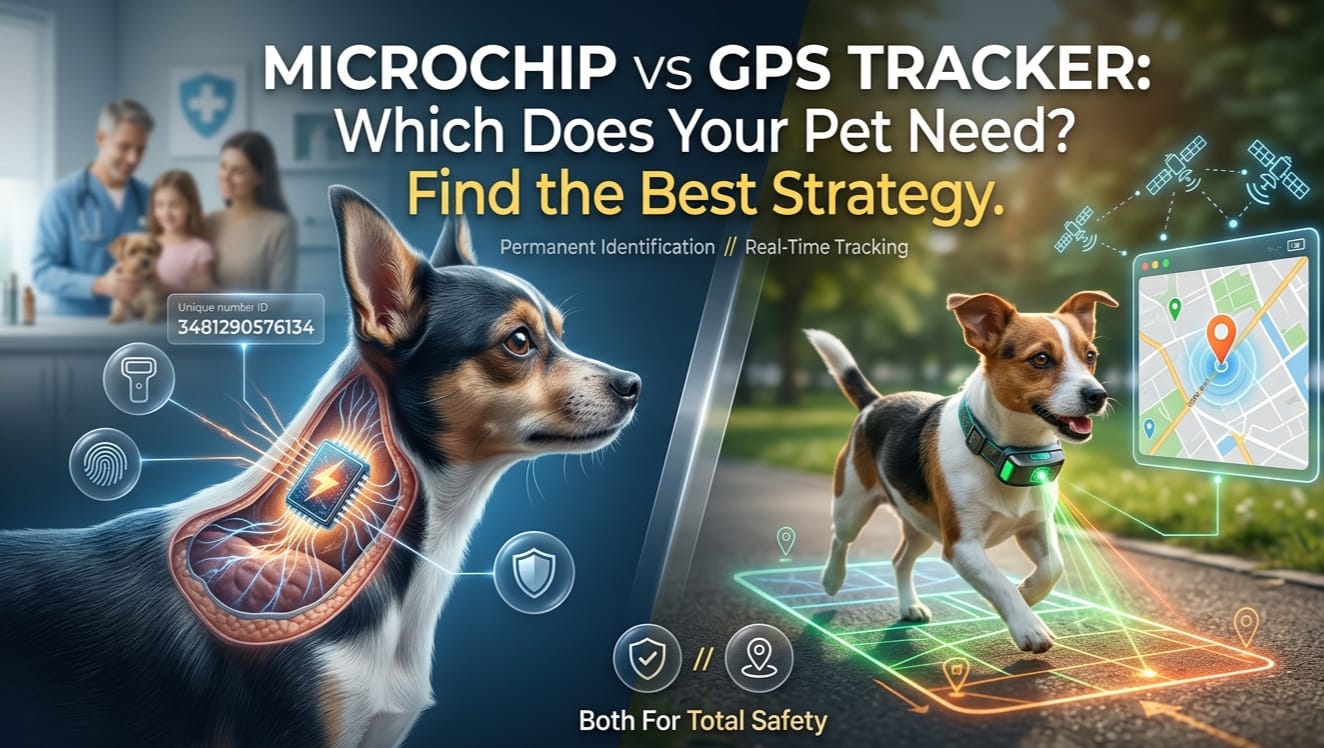
Two of the most common pet safety tools — and most owners treat them as if they are the same thing or competing alternatives. They are neither. A microchip and a GPS tracker solve completely different problems, work in completely different ways, and protect your pet at completely different moments. This guide breaks down exactly what each one does, what each one cannot do, which pets need which, and why the smartest answer for most pet owners is to use both.
Quick Answer — Microchip vs GPS Tracker
Microchip: Permanent, battery-free, lifelong ID implanted under your pet’s skin. Cannot track location. Works when a scanner is held near your pet — anywhere, anytime, forever. GPS Tracker: Real-time location tracking via a collar device. Requires battery charging and a monthly subscription. Shows you where your pet is right now. Best strategy: use both. GPS to find your pet fast. Microchip as permanent backup if the GPS fails, falls off, or runs out of battery.
Pet Microchip
$25–$75 one-time · $0/month
Permanent Identification
GPS Tracker
$30–$150 device · $5–$15/month
Real-Time Location
Table of Contents
- How Each Technology Actually Works
- Side-by-Side Feature Comparison
- Microchip: Full Pros and Cons
- GPS Tracker: Full Pros and Cons
- Best Pet GPS Trackers in 2026
- Which Does Your Pet Need? By Situation
- Why the Answer for Most Pets Is Both
- What About Apple AirTag and Bluetooth Trackers?
- Frequently Asked Questions
10M+
Pets go missing in the US every year
52%
More likely registered chipped dogs are reunited
$0
Monthly cost of a microchip after implantation
Real-time
Location updates possible with GPS — chip cannot do this
How Each Technology Actually Works
The single most important thing to understand about this comparison is that a microchip and a GPS tracker are not competing technologies. They are completely different tools solving completely different problems. Comparing them is a little like asking whether a seatbelt or a spare tire is better for your car — they do different things and you need both.
How a Microchip Works
Passive RFID Identification
- A rice-grain-sized chip is implanted under your pet’s skin
- The chip sits dormant — no signal, no battery, no activity
- A scanner held nearby sends a radio wave that briefly powers the chip
- The chip broadcasts its 15-digit ID number
- The scanner displays the number
- The number is searched in a database to find the owner
- Works anywhere, anytime, for 25+ years
How a GPS Tracker Works
Active Satellite + Cell Network
- A battery-powered device attaches to your pet’s collar
- The device continuously connects to GPS satellites
- Location data is sent over a cell network to your phone
- You see your pet’s real-time location on a map in the app
- You can set geofence alerts for when your pet leaves a zone
- Device must be charged every 1–7 days depending on model
- Requires monthly subscription for cell network access
New to pet microchips? Get the full technology breakdown in our Complete Guide to Pet Microchipping — covers everything from implantation to registration.
Side-by-Side Feature Comparison: Microchip vs GPS Tracker
| Feature | 🔬 Microchip | 📡 GPS Tracker |
|---|---|---|
| Real-time location tracking | ✗ No | ✓ Yes |
| Works without cell coverage | ✓ Yes — anywhere | ✗ No — needs signal |
| Requires battery | ✓ No battery needed | ✗ Needs charging |
| Can fall off pet | ✓ No — implanted | ✗ Yes — collar attachment |
| One-time cost | ✓ $25–$75 | ⚠ $30–$150 |
| Monthly subscription | ✓ None | ✗ $5–$15/month |
| Lifespan | ✓ 25+ years | ⚠ 2–5 years typical |
| Works if collar removed | ✓ Yes | ✗ No |
| Geofence / escape alert | ✗ No | ✓ Yes |
| Works at shelter scan | ✓ Yes — standard scan | ✗ Not applicable |
| Required for intl. travel | ✓ Yes (ISO chip) | ✗ Not required |
| Works for cats | ✓ Yes | ⚠ Limited options |
| Activity / health tracking | ✗ No | ⚠ Some models |
| Works without smartphone | ✓ Yes | ✗ Usually requires app |
Pet Microchip: Complete Pros and Cons
A microchip is the permanent safety net — the identification layer that works even when everything else has failed. Here is a fully honest look at what it does and does not offer:
Advantages of Microchipping
- Completely permanent — cannot be lost or removed
- Zero maintenance — no battery, no charging, no app
- One-time cost — no monthly fees ever
- Works anywhere in the world where shelters have scanners
- Lasts your pet’s entire lifetime (25+ years)
- Required for international travel to most countries
- Used by all animal shelters and vets as standard
- Legally recognized form of pet identification
- Works even if collar falls off or is removed
- No added weight or discomfort for your pet
Limitations of Microchipping
- Cannot track location — no GPS whatsoever
- Only works when scanned — passive technology
- Requires your pet to reach a shelter or vet first
- Useless without registration in a database
- Outdated contact details make it ineffective
- Chip can migrate from original location
- Cannot alert you the moment your pet escapes
- Cannot tell you your pet is in danger
Worried your microchip isn’t working properly? Read: Can a Microchip Fall Out or Migrate? — complete honest answer about chip migration and what to do about it.
Pet GPS Tracker: Complete Pros and Cons
A GPS tracker is the active early-warning system — the tool that tells you your pet is missing in real time and shows you exactly where they are. Here is the honest picture:
Advantages of GPS Trackers
- Real-time location — find your pet right now
- Geofence alerts — notified the moment pet leaves yard
- Active search — you can go directly to pet’s location
- Some models track activity and health metrics
- Works before your pet reaches a shelter
- Dramatically reduces time pet is missing
- Great for escape-artist dogs and outdoor cats
- Some models work internationally
Limitations of GPS Trackers
- Requires daily to weekly battery charging
- Monthly subscription fee ($5–$15/month)
- Can fall off, get caught on something, or be removed
- Needs cell coverage — dead zones exist
- Adds weight to pet’s collar — not ideal for small cats
- Device needs replacing every few years
- Cannot be used as legal ID at shelters or borders
- Useless if battery is dead when pet escapes
The Dead Battery Problem Is Real
The most common failure point of GPS trackers is simple: the battery dies and the owner forgets to recharge it. In a 2023 survey of pet owners who used GPS trackers, over 40% admitted their tracker battery had run out at some point — including during times when the pet went missing. This is exactly why a microchip — which has no battery — serves as the critical backup that GPS cannot replace.
Best Pet GPS Trackers in 2026
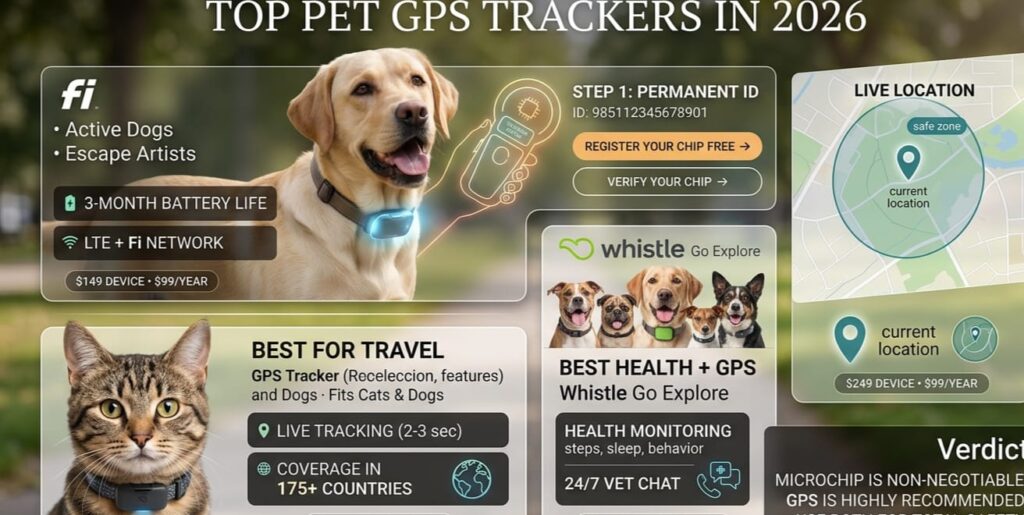
If you decide to add a GPS tracker to your pet’s safety setup — which we recommend for most dog owners — here are the top options currently available:
Fi Series 3 Dog Collar
Best Overall
$149 device · ~$11.99/month or $99/year
The Fi collar integrates GPS tracking with an escape alert system that notifies you the moment your dog leaves your yard. It uses both GPS satellites and a crowd-sourced Fi network of millions of collars for accurate indoor and outdoor tracking. Battery lasts up to 3 months in standard mode — the best battery life of any GPS collar on the market.
Battery: Up to 3 months
Network: LTE + Fi network
Best for: Active dogs, escape artists
Water resistant: Yes
Whistle Go Explore
Best Health + GPS
$79.95 device · $9.95–$14.95/month
Whistle combines GPS location tracking with health and activity monitoring — steps, sleep, calories, and behavior patterns. It uses AT&T’s LTE network for reliable coverage and includes a 24/7 pet telehealth service. If you want GPS plus insight into your pet’s daily health, Whistle is the best all-in-one option.
Battery: Up to 20 days
Network: AT&T LTE
Best for: Health-conscious owners
Water resistant: Yes
Tractive GPS
Best for Travel
$49.99 device · $4.99–$9.99/month
Tractive is available in 175+ countries — making it the best choice for pet owners who travel internationally with their dogs or cats. It offers live tracking with updates every 2–3 seconds, geofencing, and activity tracking. Most affordable GPS tracker with the widest international coverage.
Battery: Up to 7 days
Network: Multi-network, 175+ countries
Best for: Travelers and expats
Water resistant: Yes, waterproof
Garmin TT 15 Dog Device
Best Off-Grid
$249 device · No subscription required
The Garmin TT 15 is the professional choice for hunting dogs, working dogs, and owners in rural areas without reliable cell coverage. It uses GPS and GLONASS satellite systems and communicates directly with a Garmin handheld device — no cell network required. The range exceeds 9 miles. No monthly subscription fee ever.
Battery: Up to 24 hours
Network: Direct GPS, no cell needed
Best for: Rural, hunting, working dogs
Range: Up to 9 miles
GPS Trackers for Cats — A Note
Most GPS trackers are designed for dogs and are too large or heavy for cats. The Tractive GPS Cat and Tabcat are purpose-built for cats. However, many cat owners find that GPS trackers are less practical for cats than for dogs — cats often remove collars, hide in areas with poor signal, and spend significant time in buildings where GPS is less accurate. For cats, a registered microchip combined with a breakaway collar and ID tag is often the more reliable core protection.
Which Does Your Pet Need? Recommendation by Situation
Active outdoor dog — especially escape artists
→ Both microchip AND GPS tracker
High-risk dogs that jump fences or bolt need real-time tracking most urgently. GPS for immediate response, chip for backup if tracker fails or collar comes off.
Dog that goes hiking, camping, or off-leash in nature
→ Both — with Garmin or Tractive for rural coverage
In remote areas, a GPS tracker with non-cell-dependent tracking (like Garmin) is critical. Microchip ensures ID if the tracker runs out of battery on a long trip.
Indoor cat or elderly cat
→ Microchip + registered collar tag
Indoor cats that rarely escape don’t need the expense and maintenance of a GPS tracker. A registered microchip with a breakaway collar and ID tag is the right balance.
Outdoor cat or cat that escapes regularly
→ Both — use Tractive Cat or Tabcat
Outdoor cats benefit from GPS when it fits. The chip remains essential because cats frequently lose collars outdoors.
Budget-conscious owner with a calm, stay-at-home dog
→ Microchip + collar tag is sufficient
For calm, leash-walked urban dogs with low escape risk, a registered microchip and current ID tag on a collar provides solid baseline protection at minimal cost.
Pet that travels internationally
→ ISO microchip required + GPS recommended
ISO-compliant microchip is legally required for entry into EU, UK, Australia, and most countries. GPS adds security during transit and in unfamiliar environments.
Why the Answer for Most Pet Owners Is Both
The microchip vs GPS tracker debate is a false choice. The two technologies are not alternatives — they are layers of the same safety net. Think of it as a two-system approach:
- Layer 1 — Prevention and rapid response (GPS tracker): Alerts you the moment your pet leaves a defined zone. Shows you their live location. Lets you go directly to them, often before they even reach danger. This is your first line of active defense.
- Layer 2 — Permanent failsafe (microchip): Works when the GPS tracker runs out of battery. Works when the collar falls off. Works when the tracker is damaged or removed. Works five years from now. Works in a shelter anywhere in the world. This is your permanent backup that never fails.
The GPS tracker prevents the worst case. The microchip handles the worst case when prevention fails. Between them, your pet is protected from nearly every scenario — and neither is particularly expensive when you consider what it protects.
The Real-World Cost Calculation
Microchip: $50 one-time. GPS tracker: $100 device + $10/month = $220/year. Together: around $270 for the first year, $120/year after that. Compare that to the cost of lost pet flyers, reward money, boarding fees at shelters, and the emotional toll of a lost pet — and both technologies are among the best investments you can make as a pet owner.
Ready to set up your pet’s microchip protection? Read: How to Register a Pet Microchip — complete step-by-step guide to making your chip actually work.
What About Apple AirTag and Bluetooth Trackers?
Apple AirTags and similar Bluetooth trackers (Tile, Samsung SmartTag) are increasingly popular as cheap pet-tracking alternatives. Here is an honest assessment of where they fit:
What AirTag Does Well for Pets
- Cost: $29 for AirTag — significantly cheaper than dedicated GPS trackers
- Battery life: Up to 1 year on a standard CR2032 battery
- No subscription: Works entirely through the Apple Find My network for free
- Crowd-sourced network: Works by pinging off other Apple devices nearby
What AirTag Cannot Do for Pets
- Not real-time: AirTag updates location only when near another Apple device — in rural areas or forests, this can be hours or never
- No geofencing: Cannot alert you when your pet leaves a zone
- Not designed for pets: No water resistance in standard form; needs a pet-specific case
- Android incompatible: Requires iPhone to track
- Not a replacement for GPS: Useful in urban areas, unreliable in rural environments
Our Verdict on AirTag for Pets
An AirTag in a waterproof pet case is a decent budget supplement for urban pet owners — particularly those with indoor cats or city dogs. It is not a replacement for a dedicated GPS tracker for high-risk outdoor pets. Think of it as a step up from no tracking at all, but a step below a proper GPS collar subscription service.
Complete Pet Safety Setup — Our Recommended Combination
Based on everything in this guide, here is the complete pet safety setup we recommend for most dog and cat owners:
- Microchip (mandatory): $25–$75 one-time at your vet or free at a shelter event — permanent, lifelong ID
- Register the chip (mandatory, free): foundanimals.org and 24Petwatch — both free, done in 10 minutes
- Verify registration (mandatory, free): lookup.aaha.org — confirms chip is searchable by shelters
- Collar and ID tag: Always keep a current collar on your pet with your phone number — the first thing anyone checks
- GPS tracker (highly recommended for dogs): Fi Series 3 or Whistle Go for escape-prone dogs; Tractive for travel; AirTag for budget urban option
- Annual check: Ask vet to scan chip and verify registration details are still current every year
Start With the Most Important Step — It’s Free
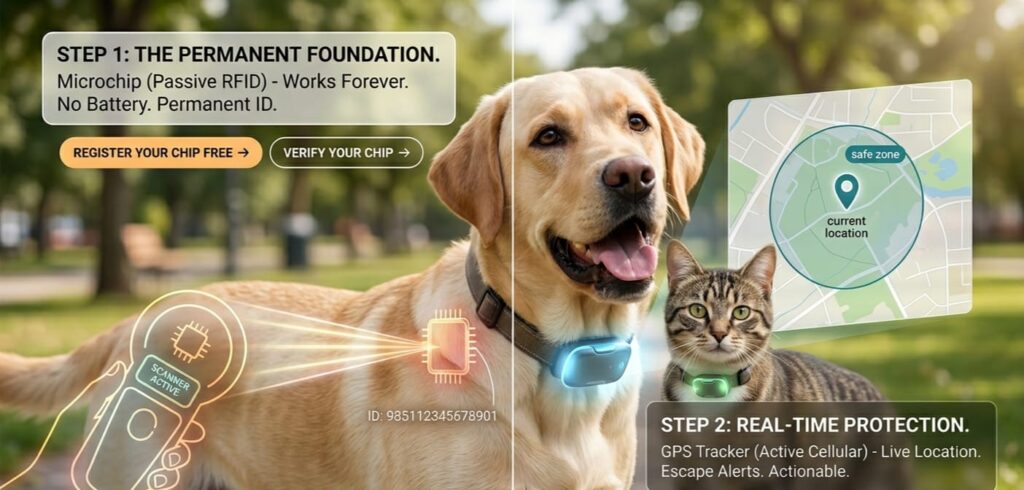
Before you spend a dollar on a GPS tracker, make sure your pet’s microchip is registered. Takes 5 minutes. Costs nothing. Works forever.Register Your Chip Free →Verify Your Chip →
Frequently Asked Questions — Microchip vs GPS Tracker
Is a microchip or GPS tracker better for pets?+
Neither is strictly better — they serve completely different purposes. A microchip is permanent identification that works anywhere, forever, with no battery. A GPS tracker provides real-time location tracking so you can find your pet immediately. The best approach for most pet owners is to use both: GPS to find your pet fast, microchip as the permanent backup when the GPS fails, runs out of battery, or falls off. Can a microchip track my pet’s location?+
No — this is the most common misconception about microchips. A microchip cannot track location. It is a passive RFID device with no GPS, no battery, and no active signal. It only transmits a 15-digit ID number when a scanner is held within a few centimetres. For real-time location tracking, you need a separate GPS collar device. Does my pet need both a microchip and GPS tracker?+
For maximum protection, yes. A microchip is mandatory for all pets — it is permanent, free to maintain, and required for international travel. A GPS tracker is highly recommended for dogs and outdoor cats with higher escape risk. The microchip handles scenarios where the GPS has failed, run out of battery, or the collar has come off. Together they cover virtually every lost pet scenario. How much does a pet GPS tracker cost per month?+
Most pet GPS trackers cost $5–$15 per month for the cell network subscription, plus the one-time device cost of $30–$150. Fi is around $11.99/month or $99/year. Whistle is $9.95–$14.95/month. Tractive is $4.99–$9.99/month. Garmin TT 15 requires no monthly subscription but uses a direct satellite connection with no smartphone app. What happens if my pet’s GPS tracker runs out of battery?+
If the GPS tracker battery dies, you lose real-time tracking entirely. This is the most critical failure mode of GPS trackers — and it happens more often than owners expect. This is precisely why a registered microchip is not optional, even for pets with GPS collars. The microchip works whether the tracker is dead, lost, or removed, and provides permanent identification through any shelter or vet visit. Is an Apple AirTag good for tracking pets?+
An AirTag is a budget option for urban pet owners — it costs $29, has year-long battery life, and uses the Apple Find My crowd-sourced network. However, it is not real-time tracking (only updates when near another Apple device), has no geofencing, and is unreliable in rural areas. It is a decent supplement for low-risk urban pets, but not a replacement for a dedicated GPS collar subscription for escape-prone dogs. Which GPS tracker is best for dogs in 2026?+
The Fi Series 3 is currently the best overall GPS dog collar — it has market-leading battery life (up to 3 months in standard mode), geofencing escape alerts, and a crowd-sourced Fi network for indoor accuracy. Whistle Go Explore is best if you also want health tracking. Tractive is best for international travel. Garmin TT 15 is best for rural areas and hunting dogs that need non-cell-dependent tracking.
Final Verdict: Microchip Is Non-Negotiable. GPS Is Highly Recommended.
After comparing every dimension of microchip vs GPS tracker, the conclusion is clear. A microchip is not optional — it is the permanent foundation of your pet’s safety, required for international travel, and the technology that brings pets home from shelters. At $25–$75 for a lifetime of protection, it is the single best value investment in pet safety that exists.
A GPS tracker is the powerful upgrade that turns “I hope someone finds my pet” into “I know exactly where my pet is right now.” For escape-prone dogs, outdoor cats, and high-activity pets, it is money very well spent.
But remember: the GPS tracker is only as good as its battery charge. The microchip works forever. For your pet’s complete protection — start with the chip, register it today, then add a GPS tracker when your budget allows.
Related Articles on Save This Life Now
Complete Guide to Pet Microchipping (2026) — Everything You Need to Know
How to Register a Pet Microchip — Full Step-by-Step Guide
Best Pet Microchip Registries in the USA (2026 Comparison)
How Much Does It Cost to Microchip a Dog? (2026 Price Guide)
How to Check If Your Dog Is Already Microchipped — 4 Free Methods
Does Microchipping a Dog Hurt? What Vets Really Say
Can a Microchip Fall Out or Migrate? Complete Honest Answer
How Long Does a Pet Microchip Last? The Complete Truth
What to Do After Your Pet Is Microchipped — Complete Next Steps
My Dog Is Missing — What to Do in the First 24 Hours
