

Microchip GuideBy Save This Life Now TeamUpdated:
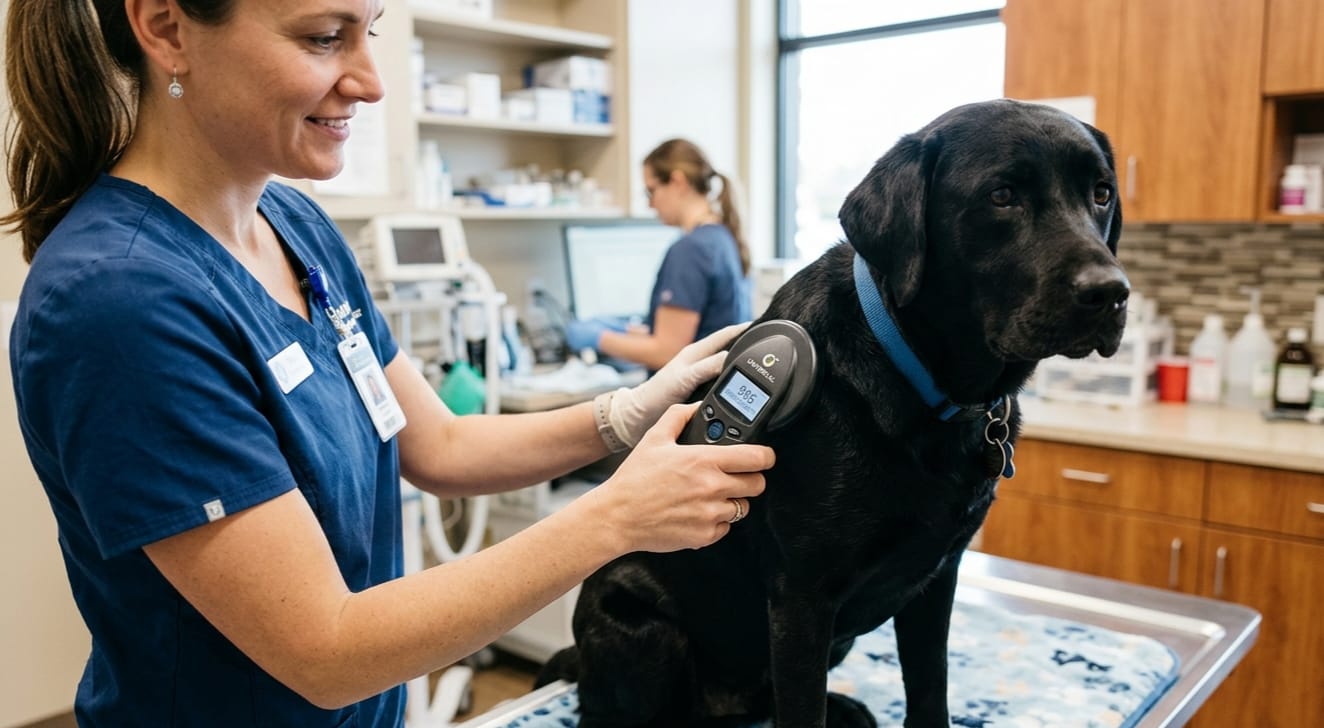
This is one of the most searched questions about pet microchips — and the confusion is completely understandable. There are dozens of microchip brands, two different radio frequencies, and not every scanner reads every chip. So what is the real answer? Can your vet scan any microchip brand — no matter which one your pet has? Here is the complete, honest explanation of how chip scanning actually works, what could go wrong, and what to do if your pet’s chip isn’t being detected.
Direct Answer — Can a Vet Scan Any Microchip Brand?
Yes — in most cases. Most modern vets and all reputable animal shelters use universal scanners that can read microchips from any brand, operating at both 134.2 kHz (ISO standard) and 125 kHz (older non-ISO chips). However, some older vet clinics may still use single-frequency scanners that only detect one chip type. The safest thing to do is ask your vet directly: “Do you have a universal scanner that reads both ISO and non-ISO chips?”
Table of Contents
- How Microchip Scanning Actually Works
- ISO vs Non-ISO Chips: The Core Difference You Must Understand
- What Is a Universal Microchip Scanner?
- Common Microchip Brands and Which Frequency They Use
- Can Animal Shelters Scan Any Microchip Brand?
- What to Do If Your Pet’s Microchip Is Not Being Detected
- Microchip Scanning and International Pet Travel
- Frequently Asked Questions
2
Main chip frequencies: 125 kHz and 134.2 kHz
15
Digits in a modern ISO microchip number
2007
Year USA moved toward ISO standard chips
100+
Countries requiring ISO chips for pet entry
How Microchip Scanning Actually Works
Before answering whether a vet can scan any microchip brand, it helps to understand exactly what scanning involves — because the technology is what determines compatibility, not the brand name on the chip.
A pet microchip is a passive RFID (Radio Frequency Identification) device. It has no battery and produces no signal on its own. It only activates when a scanner passes close to it — the scanner emits a low-frequency radio wave that powers the chip for a fraction of a second, just long enough for the chip to broadcast its unique identification number back to the scanner.
How the Scanning Process Works Step by Step
- Scanner emits a radio waveThe scanner generates a low-frequency electromagnetic field in the area being scanned — typically between your pet’s shoulder blades and the surrounding area.
- The chip absorbs the energy and activatesWhen the radio wave from the scanner reaches the chip’s antenna coil, the chip converts that energy into just enough power to activate its transmitter — for less than a millisecond.
- The chip broadcasts its ID numberThe activated chip transmits its unique 9, 10, or 15-digit identification number back to the scanner at its operating frequency.
- The scanner receives and displays the numberThe scanner’s receiver detects the signal, decodes the number, and displays it on the screen. The whole process happens in under a second.
- The number is searched in a databaseThe displayed number is then looked up in a microchip registry database — like the AAHA Universal Lookup at lookup.aaha.org — to find the registered owner’s contact information.
The key compatibility question is this: the scanner must emit a radio wave at the same frequency that the chip operates on. If they are on different frequencies, the chip never activates — and the scanner shows no result. This is why frequency compatibility is the core issue when asking whether a vet can scan any microchip brand.
Want to understand exactly how microchips work inside your pet’s body? Read our Complete Guide to Pet Microchipping — covers the technology, procedure, cost, and registration in full detail.
ISO vs Non-ISO Chips: The Core Difference You Must Understand
This is the heart of the whole “can a vet scan any microchip brand” question. There are two main types of pet microchips based on their operating frequency — and understanding the difference between them explains everything else.
Modern Standard
ISO Chips (134.2 kHz)
- Follows ISO 11784/11785 international standard
- Operates at 134.2 kHz frequency
- Produces a 15-digit ID number
- Required for international pet travel to most countries
- Used in virtually all chips implanted after 2007
- Read by all modern universal scanners
- Most common chip type in the USA today
Older Standard
Non-ISO Chips (125 kHz)
- Pre-dates the ISO international standard
- Operates at 125 kHz frequency
- Produces a 9 or 10-digit ID number
- Not accepted for international travel to most countries
- Commonly implanted before 2007 in the USA
- Requires a scanner that reads 125 kHz
- Still in millions of older pets in the USA
How to Tell Which Type of Chip Your Pet Has
The quickest way is to look at the chip number length:
- 15-digit number → Your pet has a modern ISO 134.2 kHz chip
- 9 or 10-digit number → Your pet likely has an older non-ISO 125 kHz chip
- Chipped after 2007 → Almost certainly an ISO chip
- Chipped before 2007 → May be a non-ISO chip — verify with your vet
Millions of US Pets Still Have Non-ISO Chips
Because the US was slower to adopt the ISO standard than Europe and Australia, there are still millions of pets in the United States with older 125 kHz non-ISO chips. If your pet was microchipped before 2007 — or adopted from a rescue that was using older inventory — there is a real chance your pet has a non-ISO chip. This doesn’t mean the chip is broken — it just means not every scanner will detect it.
Not sure if your pet even has a chip? Read our complete guide: How to Check If Your Dog Is Already Microchipped — 4 free methods including the fastest way to get an answer today.
What Is a Universal Microchip Scanner?
A universal microchip scanner — also called a multi-frequency or forward and backward reading scanner — is a device that can detect microchips operating at multiple frequencies in a single scan. This is the key technology that allows a single scan to detect any chip brand, regardless of when or where it was implanted.
Most modern universal scanners read chips at:
- 134.2 kHz — the international ISO standard used in all modern chips
- 125 kHz — the older frequency used in pre-2007 chips in the US
- Some advanced scanners also read 128 kHz chips used in some European countries
Which Vets and Shelters Have Universal Scanners?
All reputable animal shelters in the USA use universal scanners — this is standard practice for animal welfare organizations. Most modern vet clinics also have them, but some smaller or older practices may still use single-frequency scanners. If you are unsure, simply ask your vet: “Do you have a universal scanner that reads both 125 kHz and 134.2 kHz chips?” A good vet will answer clearly and without hesitation.
What Happens If a Vet Only Has a Single-Frequency Scanner?
If a vet uses an older scanner that only reads 134.2 kHz ISO chips, and your pet has an older 125 kHz non-ISO chip, the scanner will show no result — even though the chip is perfectly functional. This is not a chip failure. It is a scanner compatibility issue. The chip is there. The scanner just can’t hear it.
This scenario is precisely why asking whether your vet has a universal scanner matters — especially if your pet is older or was chipped before 2007.
Common Microchip Brands and Which Frequency They Use
Here is a breakdown of the most widely used microchip brands in the USA and the frequency each uses — so you know whether any standard scanner will detect your pet’s specific chip:
HomeAgain (Merck Animal Health)
Modern chips: 134.2 kHz ISO — 15-digit number
ISO ✓
AVID (American Veterinary Identification Devices)
Newer chips: 134.2 kHz ISO · Older EuroChip: 125 kHz
Both
Datamars (Micro-ID)
134.2 kHz ISO — 15-digit number
ISO ✓
Allflex USA
134.2 kHz ISO — 15-digit number
ISO ✓
24Petwatch chips
134.2 kHz ISO — 15-digit number
ISO ✓
Bayer ResQ (Destron Fearing)
134.2 kHz ISO — 15-digit number
ISO ✓
AVID Original (pre-2007)
125 kHz non-ISO — 9 or 10-digit number
Non-ISO ⚠
Digital Angel (pre-2007)
125 kHz non-ISO — 10-digit number
Non-ISO ⚠
Rule of Thumb
If your pet was microchipped after 2007 in the United States, Canada, or virtually anywhere in Europe or Australia, the chip is almost certainly an ISO 134.2 kHz chip that any universal scanner will detect. If your pet was chipped before 2007, especially in the USA, verify the chip frequency with your vet to make sure you know what type of chip your pet has.
Can Animal Shelters Scan Any Microchip Brand?
Yes — all reputable animal shelters use universal scanners. This is the standard equipment requirement for any professional animal welfare organization in the United States. When a stray animal arrives at a shelter, the staff scan the entire body — not just the standard shoulder blade location — using a universal scanner to ensure no chip is missed.
Shelter staff are specifically trained to:
- Use universal scanners that read all chip frequencies
- Scan the entire body of incoming animals, not just the standard implant location — because chips can migrate over time
- Scan slowly in a figure-eight pattern to maximize detection of any chip type
- Use the AAHA Universal Pet Microchip Lookup to search detected chip numbers across multiple databases
Shelters Are Your Best Scanner Resource
If you are unsure whether your pet has a chip — or which type — walk into any animal shelter with your pet and ask for a free scan. Shelters have the best scanning equipment and the most experienced staff. They will scan your pet completely, tell you the chip number if one is detected, and often help you look it up in the AAHA database on the spot. No appointment or fee required.
Want to know the exact steps for getting your pet scanned at a shelter? Read: How to Check If Your Dog Is Already Microchipped — covers all 4 scanning methods with step-by-step instructions.
What to Do If Your Pet’s Microchip Is Not Being Detected
If a vet or shelter scans your pet and finds no chip — but you believe one was implanted — don’t panic immediately. There are several possible explanations, and most have simple solutions.
Reason 1: The Scanner Is Not Universal
The most common explanation. If the vet is using an older single-frequency scanner and your pet has a chip of a different frequency, the scanner simply will not detect it. Solution: Ask your vet to use a universal scanner, or visit a local animal shelter for a free universal scan.
Reason 2: The Chip Has Migrated From the Standard Location
Microchips can shift from their original implant location over time — sometimes moving several inches from between the shoulder blades. This is harmless and more common in younger, more active dogs. Solution: Ask the scanner operator to scan the entire body slowly in a wide pattern, not just the standard area between the shoulder blades.
Reason 3: The Chip Has Failed
Chip failure is rare but possible. The chip may have stopped transmitting — this can happen due to manufacturing defects or (very rarely) physical damage to the implant site. Solution: If a universal scanner covering the entire body finds nothing, your vet can confirm chip failure. A new chip can be implanted at a different location.
Reason 4: The Wrong Number Was Recorded
Occasionally, paperwork contains a typo in the chip number. The chip itself is fine, but the wrong number was recorded at the time of implantation. Solution: Ask your vet to physically scan your pet and compare the displayed number to your paperwork. If there’s a discrepancy, update your registry records with the correct number.
What to Do If You Think Your Pet’s Chip Has Failed
If a universal scanner covering your pet’s entire body finds no chip, speak with your vet about implanting a new one at a different location — typically the left side of the neck or flank area. A failed chip can be left in place (it poses no health risk) while a new functional chip is implanted. The new chip should then be registered in your pet’s existing registry profile.
Once you confirm your pet’s chip number, the most important next step is registration. Read: How to Register a Pet Microchip — complete step-by-step guide to registering in the right databases so shelters can always find you.
Microchip Scanning and International Pet Travel
If you travel internationally with your pet, the ISO vs non-ISO chip distinction becomes critically important — not just for scanning, but for legal entry requirements.
| Country / Region | ISO Chip Required? | Non-ISO Chip Accepted? | Notes |
|---|---|---|---|
| European Union | ✓ Yes | ✗ No | ISO 134.2 kHz chip mandatory for all pets entering EU countries |
| United Kingdom | ✓ Yes | ✗ No | ISO chip required post-Brexit; chip must be implanted before rabies vaccination |
| Australia & New Zealand | ✓ Yes | ✗ No | Strict biosecurity — ISO chip required, plus quarantine period |
| Canada | ⚠ Recommended | ⚠ Often accepted | No federal chip requirement but ISO preferred by vets and shelters |
| Japan | ✓ Yes | ✗ No | ISO chip required; very strict import rules — plan 6–12 months ahead |
| USA (domestic) | ⚠ No law, but standard | ⚠ Works with universal scanner | No federal requirement, but ISO is now the de facto standard for new implants |
Traveling Internationally With an Older Non-ISO Chip
If your pet has a 125 kHz non-ISO chip and you plan to travel to the EU, UK, Australia, or most of Asia, you will likely need to have a new ISO-compliant chip implanted before travel. The old chip can remain in place — it will simply be supplemented by the new ISO chip. Check the specific entry requirements of your destination country at least 6 months before travel, as many countries have vaccination and documentation requirements that must be completed in a specific order relative to microchipping.
What to Do Right Now — Microchip Scanning Checklist
- Ask your vet: “Do you have a universal scanner that reads both 125 kHz and 134.2 kHz chips?”
- Find your pet’s chip number — check paperwork or ask vet to scan
- Count the digits: 15 digits = ISO chip; 9-10 digits = older non-ISO chip
- Verify your chip is registered at lookup.aaha.org
- If unregistered — go to foundanimals.org and register for free today
- If planning international travel — check destination chip requirements 6 months ahead
- Ask your vet to scan the chip at every annual wellness visit to confirm it’s still working
Is Your Pet’s Chip Registered and Findable?
Verify your chip in the universal database shelters use — takes 2 minutes and is completely free.Check Your Chip at AAHA →Register Free Today →
Frequently Asked Questions — Can a Vet Scan Any Microchip Brand?
Can a vet scan any microchip brand?+
Yes — as long as the vet uses a universal scanner. Most modern veterinary clinics and all reputable animal shelters use universal scanners that read chips at both 134.2 kHz (ISO standard) and 125 kHz (older non-ISO chips). The only situation where a chip may not be detected is if the vet uses an older single-frequency scanner. If you’re unsure, ask your vet directly: “Do you have a universal scanner?”What is the difference between ISO and non-ISO microchips?+
ISO chips follow the international ISO 11784/11785 standard, operate at 134.2 kHz, and produce a 15-digit number. They are used in virtually all chips implanted after 2007 worldwide. Non-ISO chips operate at 125 kHz and produce a 9 or 10-digit number. They were common in the USA before 2007. Both types work fine for domestic identification, but only ISO chips are accepted for international pet travel to most countries.What should I do if a vet cannot find my pet’s microchip?+
First, ask whether they have a universal scanner that reads both 125 kHz and 134.2 kHz chips. If not, visit a local animal shelter for a free universal scan. If a universal scanner finds nothing after scanning the whole body — not just the shoulder blades — the chip may have migrated, failed, or never been implanted. Your vet can implant a new chip if needed.Do animal shelters have universal scanners?+
Yes. All reputable animal shelters use universal scanners as standard equipment. This is a requirement for professional animal welfare organizations, since missing a chip on an incoming stray animal could prevent a reunion with the owner. Shelter staff are also trained to scan the entire animal body — not just the standard shoulder blade location — to account for chip migration.Can a microchip be read through thick fur?+
Yes. Microchip scanners detect chips through skin, fur, and subcutaneous tissue — the thickness of your pet’s coat does not interfere with detection. The scanner’s radio wave penetrates several centimetres of tissue. However, the scanner must be held close to the implant site — within a few centimetres — and moved slowly across the area to ensure the chip is within range.Does my pet need a specific microchip brand for international travel?+
For most international travel — especially to EU countries, the UK, Australia, and Japan — your pet must have an ISO-compliant 134.2 kHz chip producing a 15-digit number. The brand does not matter as long as it is ISO-compliant. If your pet has an older 125 kHz non-ISO chip, you will likely need a new ISO chip implanted before travel. Always check entry requirements for your specific destination at least 6 months in advance.How do I know if my pet’s microchip is ISO compliant?+
Check the chip number length: a 15-digit number means your pet has an ISO-compliant chip. If the number is 9 or 10 digits, it is an older non-ISO chip. You can also ask your vet to confirm the chip frequency, or check the original documentation from when the chip was implanted. If your pet was chipped after 2007 in the US, Canada, or Europe, the chip is almost certainly ISO-compliant.Can a microchip be scanned through a carrier or kennel?+
Generally, no — the scanner needs to be held directly against or very close to the animal’s body to activate and detect the chip. The radio frequency used by pet microchips has very limited range, which is why the scanner must be held within a few centimetres of the implant site. If your pet is inside a plastic carrier, the vet will need to scan the pet directly by placing the scanner against the carrier wall near the pet’s back — or take the pet out for a more reliable scan.
The Bottom Line: Most Vets Can Scan Any Chip — But Always Ask
The direct answer to “can a vet scan any microchip brand?” is: yes, in most cases — as long as they use a universal scanner. The vast majority of modern vet clinics and all professional animal shelters have universal scanners that detect chips from every major brand operating at both 125 kHz and 134.2 kHz frequencies.
The key things to remember are: ask your vet whether their scanner is universal, know whether your pet’s chip is ISO or non-ISO (check the digit count), and verify your registration at lookup.aaha.org so that when the chip is found, it leads straight back to you.
A chip that can be scanned but leads to no registered owner is still a chip that cannot bring your pet home. Make sure both halves of the equation — the chip and the registration — are working together.
Related Articles on Save This Life Now
Complete Guide to Pet Microchipping (2026) — Everything You Need to Know
How to Register a Pet Microchip — Full Step-by-Step Guide
Best Pet Microchip Registries in the USA (2026 Comparison)
How to Check If Your Dog Is Already Microchipped — 4 Free Methods
How Much Does It Cost to Microchip a Dog? (2026 Price Guide)
Does Microchipping a Dog Hurt? What Vets Really Say
What to Do After Your Pet Is Microchipped — Complete Next Steps Guide
Microchipping Cats: Complete Guide for Cat Owners
My Dog Is Missing — What to Do in the First 24 Hours
