

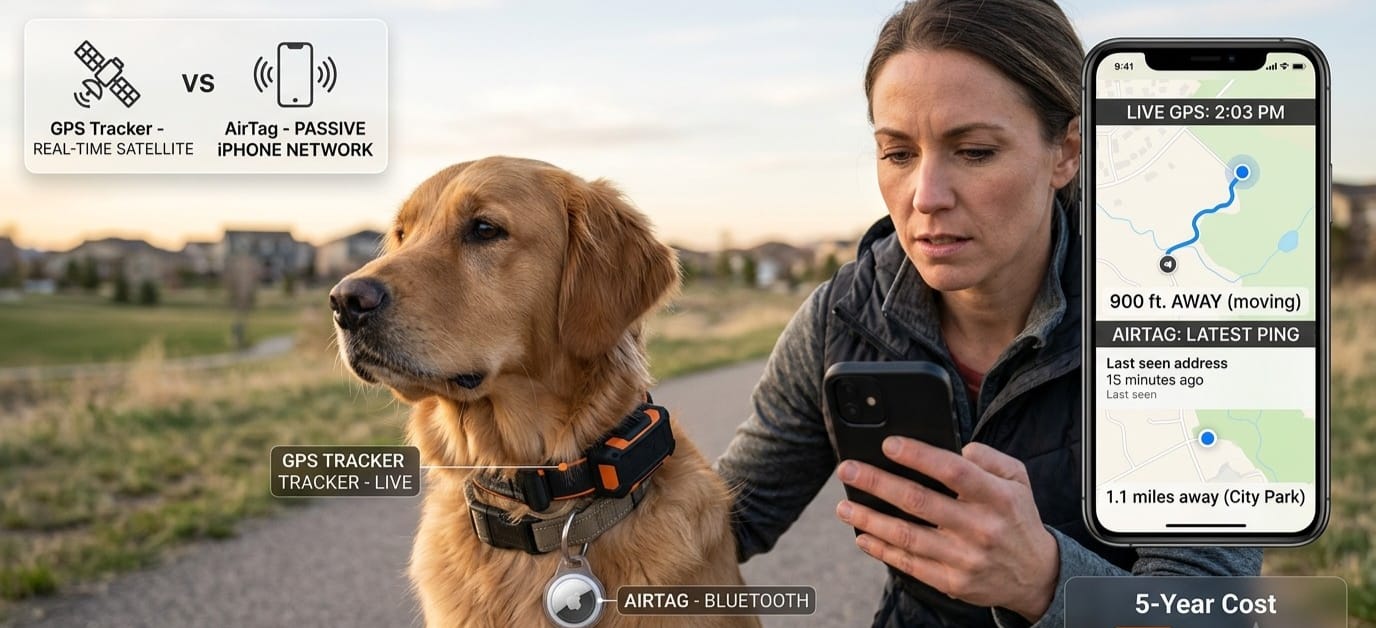
Introduction: Your Dog Just Bolted — Which Device Would Have Found Them?
Your dog slips through an open gate and is gone in seconds. You grab your phone. You pull up a tracking app. And then — nothing.
That moment of silence is the difference between an AirTag and a GPS tracker. And for dog owners who have been through it, it is not a theoretical distinction. It is the moment that reveals whether the device on your dog’s collar actually works for finding a running animal — or whether it was designed for something else entirely.
Apple AirTag vs GPS tracker for dogs is one of the most-searched questions among pet owners right now — and for good reason. AirTags are cheap, have no monthly fee, and last a year on a single battery. GPS trackers cost more, require subscriptions, but provide something the AirTag fundamentally cannot: real-time location of a moving dog, anywhere, right now.
This is the complete, honest comparison. No marketing spin. By the end, you will know exactly which device belongs on your dog’s collar — and why the answer may surprise you depending on where you live and what kind of dog you have.
If your dog has already gone missing: Stop reading this and go directly to our Step-by-Step Lost Dog Recovery Guide (internal link) — then come back here to equip yourself before it happens again.
What These Two Technologies Actually Are (And Are Not)
Before comparing them, you need to understand what each device fundamentally does — because most comparison articles get this wrong by treating them as the same category of product. They are not.
What Is an Apple AirTag?
An Apple AirTag is a Bluetooth-based item locator — a coin-sized disc designed by Apple to help people find misplaced personal belongings like keys, wallets, and bags.
It works by emitting a Bluetooth Low Energy (BLE) signal that is detected by nearby iPhones in Apple’s “Find My” network. When any iPhone with cellular service comes within Bluetooth range of your AirTag (approximately 30 to 100 feet), that phone anonymously and securely reports the AirTag’s location to Apple’s servers, and you receive a notification with the address.
Key technical fact: An AirTag has no GPS chip. It does not connect to satellites. It does not use cellular data. It cannot report its location independently. Its only intelligence is “I am near this iPhone right now.”
Apple itself has been clear on this. As Apple VP Kianne Drance stated at the product’s original launch: “AirTag is designed to track items, not people or pets.” Apple has not revised this position, including with the AirTag 2 released in January 2026 — which improved Bluetooth range and motion detection but retained the same fundamental architecture.
AirTag Fast Facts:
- Technology: Bluetooth Low Energy + Apple Find My Network
- Real-time tracking: No
- Requires GPS: No
- Battery: CR2032 coin cell (~1 year)
- Subscription fee: None
- Price: ~$29 (single), ~$99 (4-pack)
- Works with Android: No
- Designed for pets: No (Apple explicitly states this)
What Is a GPS Dog Tracker?
A GPS dog tracker is a dedicated pet safety device that uses a combination of GPS satellite technology, cellular LTE network connectivity, and often WiFi triangulation to report your dog’s exact location to your smartphone in real time.
Unlike the AirTag, it does not need any other device nearby to work. It communicates directly from the tracker on your dog’s collar → to satellites overhead → through a cellular network → to your phone. This means it works whether your dog is in your neighborhood or in the middle of a field three miles away.
GPS Tracker Fast Facts:
- Technology: GPS satellite + LTE cellular + WiFi
- Real-time tracking: Yes
- Location updates: Every 2–60 seconds depending on mode
- Battery: Rechargeable (2 days to 3 months depending on model)
- Subscription fee: Required ($5–$15/month)
- Works with Android: Yes
- Designed for pets: Yes (purpose-built)
The Core Difference That Matters When Your Dog Runs Away
Here is the single most important fact in this entire comparison:
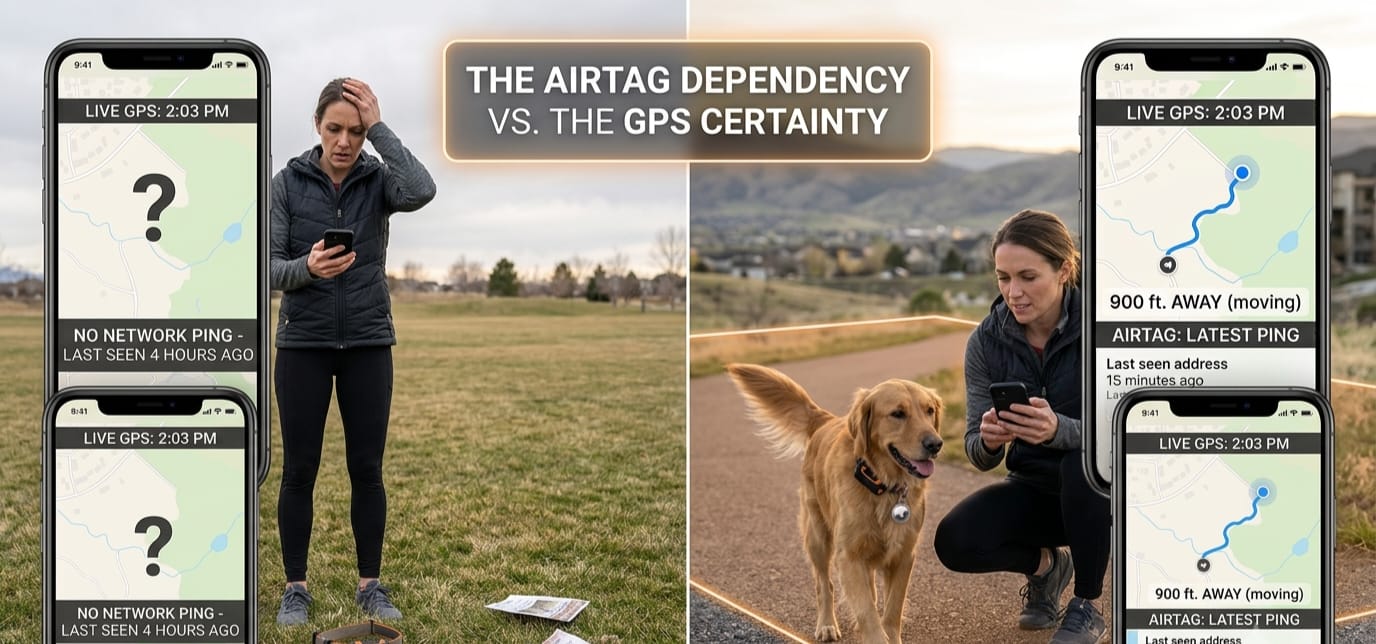
An AirTag only knows where your dog is when an iPhone happens to pass near them.
If your dog bolts into a park, a field, a neighborhood with few iPhone users, or a rural area, the AirTag goes silent. You receive no location update until another iPhone comes within Bluetooth range of your dog’s collar — which could be minutes, hours, or never.
A GPS tracker knows where your dog is continuously, right now, as long as there is cellular signal or satellite visibility. The moment your dog crosses your fence line, you get a push notification. You open the app and see a moving dot on a map showing exactly where they are.
The analogy is simple: an AirTag is like leaving someone’s business card on your dog’s collar and hoping someone calls you. A GPS tracker is like putting a live phone call on your dog’s collar that you can answer at any time.
For a lost dog — especially one that runs fast and far — this difference is not a minor technical distinction. It is the difference between getting your dog back in 20 minutes and spending three days putting up flyers.
Side-by-Side Comparison: Apple AirTag vs GPS Tracker for Dogs
| Feature | Apple AirTag | GPS Dog Tracker |
|---|---|---|
| Tracking technology | Bluetooth + Find My Network | GPS satellites + LTE cellular |
| Real-time location | No | Yes |
| Works in rural areas | No | Yes (with cell coverage) |
| Works in urban areas | Yes (if iPhones nearby) | Yes |
| Geofence escape alerts | Limited (passive notification) | Instant push alerts |
| Location update speed | Minutes to hours | Every 2–60 seconds |
| Android compatible | No | Yes |
| Waterproof | IP67 (water resistant) | IP67–IP68 on most models |
| Battery life | ~1 year (non-rechargeable) | 2 days – 3 months (rechargeable) |
| Battery danger to dogs | Yes (CR2032 swallowing risk) | Sealed rechargeable battery |
| Monthly subscription | None | $5–$15/month |
| Device cost | ~$29 | $50–$200 |
| Health monitoring | No | Yes (on premium models) |
| Designed specifically for pets | No | Yes |
| Works if dog chews collar | Battery hazard | Safer (sealed unit) |
| Total 5-year cost | ~$30 | $350–$1,100 |
Where AirTag Works for Dog Tracking (And Where It Fails)
When an AirTag Can Help
An AirTag is not completely useless for dog tracking — but its usefulness is narrow and environment-dependent.
An AirTag works reasonably well in these specific scenarios:
Dense urban neighborhoods. In a city like New York, Chicago, or Los Angeles, iPhones are everywhere. Your dog escaping in a Manhattan neighborhood has a reasonable chance of passing within Bluetooth range of someone’s iPhone within minutes, triggering a location update. Independent testing found the AirTag to be fairly reliable in cities where it came into frequent contact with other smart devices.
Short escapes close to home. If your dog slips out the front door and wanders your block or two, the AirTag’s Precision Finding feature (which uses Ultra Wideband technology) can guide you toward them with a compass-style direction indicator on your phone, pinging the AirTag to make a sound. For nearby recoveries in iPhone-dense areas, this works.
Budget-limited owners with primarily indoor dogs. For a dog that stays mostly indoors and occasionally gets out in an urban area, an AirTag in a secure collar holder provides some peace of mind at very low cost.
As a backup layer on top of a GPS tracker. Some experienced pet owners use both: the GPS tracker for real-time primary tracking, and an AirTag as a backup in case the GPS tracker’s battery dies or the device falls off.
Where AirTag Fails for Dog Tracking
Rural and suburban areas. If your dog escapes in a neighborhood, suburb, park, or rural area with fewer iPhone users, the AirTag provides no useful information. In testing, it was found to be completely non-functional in areas with sparse Apple device density. For dogs that run into fields, woods, or open spaces — which is exactly what escape-prone breeds do — the AirTag provides no tracking capability.
Fast-running or long-distance escape scenarios. A Husky, Beagle, or Greyhound that bolts and covers two miles in ten minutes will not stay close to iPhones. The AirTag will show a last-known location from when your dog passed a phone earlier — and then go dark.
Android users. If you do not have an iPhone, an AirTag does not work. Period. AirTags are entirely dependent on Apple’s Find My network, which requires iPhones. Android users cannot use AirTag as a dog tracker in any meaningful way.
Anti-stalking alert interference. Apple’s AirTag anti-stalking protections are designed to alert anyone who has an unknown AirTag “moving with them.” If a person finds your dog and holds them for more than a few minutes, they may receive an alert on their iPhone notifying them that an unknown AirTag is near them. This can lead to the finder removing the AirTag from your dog’s collar — eliminating your only tracking mechanism precisely when you need it most.
When your dog is found by a Good Samaritan without an iPhone. If the person who finds your dog does not have an iPhone, they cannot trigger an AirTag location update. You will receive nothing.
The AirTag Safety Problem Nobody Talks About Enough
Beyond the tracking limitations, there is a significant physical safety concern with using an AirTag on any dog’s collar — especially dogs that chew, play rough, or are left unsupervised.
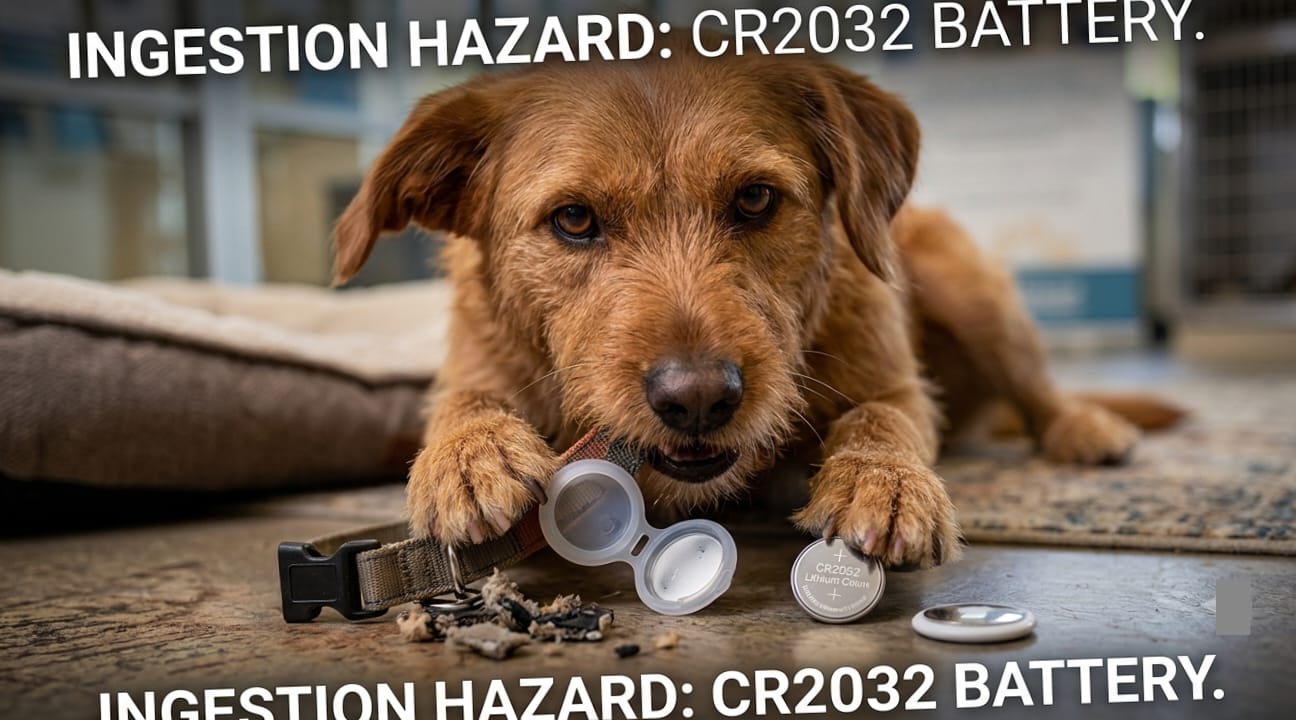
An AirTag contains a CR2032 lithium coin cell battery. Apple itself warns explicitly on its product packaging: “INGESTION HAZARD: This product contains a button cell or coin battery. DEATH or serious injury can occur if ingested. A swallowed button cell or coin battery can cause Internal Chemical Burns in as little as 2 hours.” <br>
This is not a remote risk for dogs. A veterinarian in Louisiana reported treating 6 dogs that had swallowed AirTags in an 18-month period. One dog owner discovered their missing AirTag not through the Find My app, but by triggering the AirTag’s sound feature — and hearing it coming from inside the dog’s stomach.
The U.S. Consumer Product Safety Commission (CPSC) issued a formal Notice of Violation to Apple in early 2025 after finding that AirTags imported after March 2024 were missing required battery warning labels under Reese’s Law. Apple has since updated its warning labels, but the underlying hazard has not changed.
The CR2032 battery in an AirTag can cause severe esophageal burns in as little as 2 hours if swallowed. For a dog that chews its collar, gnaws at its tags, or removes accessories and chews them — which describes a significant number of dogs — the AirTag on a collar holder represents a genuine medical emergency risk.
GPS dog trackers use sealed rechargeable lithium-polymer batteries that are integrated into the device body and not accessible without tools. They do not pose the same ingestion risk.
If your dog is a chewer, an AirTag is not a safe option for collar attachment.
Important: How to Keep Your Dog Safe — The Complete Pre-Loss Preparation Guide (internal link)
The Best GPS Trackers for Dogs in 2025–2026: What Actually Works
If you have read this far, you know that for a dog that runs away — especially in suburban or rural settings — a dedicated GPS tracker is the safer, more reliable tool. Here is an honest breakdown of the leading options currently available.
1. Tractive GPS Dog Tracker — Best Overall
Tractive is consistently the top-rated GPS tracker for dogs in independent testing and is now the dominant brand in the space following its 2025 acquisition of Whistle (which was subsequently discontinued in August 2025).
In independent testing, the Tractive GPS dog tracker delivered battery life that significantly exceeded its rated 14 days, with one reviewer achieving nearly 30 days on a single charge with daily use including walks and hikes. Its tracking uses multiple satellite systems (GPS, GLONASS, and Galileo) combined with multi-carrier cellular switching, which means it does not go dead if your dog crosses an area with weak coverage from a single carrier.
Tractive GPS Key Specs:
- Battery life: Up to 30 days (real-world)
- Location updates: Every 2–60 seconds (live tracking mode: every 2–3 seconds)
- Geofencing: Customizable virtual fence with instant escape alerts
- Health monitoring: Activity, sleep, and behavior tracking
- Subscription: ~$5/month (annual plan)
- Device cost: ~$50–$80
- Weight: ~35g (suitable for medium and large dogs; check sizing for small breeds)
- Waterproof: IP67
Best for: Most dog owners, especially those with medium to large breeds who live in suburban or rural areas. Also the best value proposition given the combination of low subscription cost and strong performance.
2. Fi Series 3 Smart Collar — Best Battery Life
The Fi Series 3 is a full smart collar with the GPS tracker built into the collar band itself (rather than a clip-on attachment). Its standout feature is an exceptional battery life rated at 3 months — though real-world testing typically yields about 3 weeks with regular use, which is still dramatically longer than most competitors.
Fi Series 3 Key Specs:
- Battery life: Up to 3 months rated (3–4 weeks real-world)
- Location updates: Every 5 minutes standard; live tracking mode available
- Geofencing: Customizable with instant escape alerts
- Network: AT&T LTE-M (check AT&T coverage in your area before purchasing)
- Subscription: ~$8.25/month (annual plan)
- Device cost: ~$149–$209
- Best for: Medium to large dogs; owners who want an all-in-one collar with the longest recharge interval
Consideration: The Fi Series 3 runs on AT&T’s LTE-M network. In areas where AT&T coverage is poor, tracking performance drops significantly. Check your local AT&T coverage before choosing Fi.
3. Garmin Alpha GPS System — Best for Wilderness and Working Dogs
If you run your dog in wilderness areas, hunt with your dog, or live in truly remote areas with limited cellular coverage, neither the Tractive nor Fi will reliably track your dog because both require cellular network connectivity to transmit location data.
The Garmin Alpha system — a handheld device paired with a GPS collar like the TT25 — uses satellite-based positioning that does not depend on cellular towers. Location updates can be set as frequently as every 10 seconds and work in environments where no cellular signal exists.
Garmin Alpha Key Specs:
- Technology: Satellite GPS (no cellular required)
- Location updates: Every 10 seconds
- Coverage: Remote wilderness, no cell service required
- Battery: Multiple-day (handheld and collar battery independent)
- Cost: $600–$1,000+ (handheld + collar bundle)
- Best for: Hunting dogs, dogs in wilderness areas, working dogs that cover large distances
Consideration: This is a professional-grade system at a professional-grade price. For most pet owners, the Tractive or Fi is sufficient. The Garmin is for extreme use cases.
4. Halo Dog Collar — Best for GPS-Based Virtual Fence Training
The Halo collar combines GPS tracking with a GPS-based wireless fence system — instead of an underground wire, you set GPS coordinates as boundaries, and the collar provides audio and vibration feedback when your dog approaches the boundary. This is primarily a training and containment tool rather than a lost-dog recovery tool.
Best for: Owners who want wireless boundary training without underground installation, combined with GPS tracking capability.
The Total Cost Breakdown: AirTag vs GPS Tracker Over 5 Years
One of the strongest selling points of the AirTag is its low upfront cost and zero subscription fee. But how does this compare to a GPS tracker’s total cost of ownership over a dog’s lifetime?
| Apple AirTag | Tractive GPS | Fi Series 3 | |
|---|---|---|---|
| Device cost | $29 | $50 | $149 |
| Monthly subscription | $0 | ~$5 | ~$8.25 |
| Year 1 total | $29 | $110 | $249 |
| Year 3 total | $29 | $230 | $447 |
| Year 5 total | $29 | $350 | $645 |
| Battery replacement (annual) | $1–$2 | $0 (rechargeable) | $0 (rechargeable) |
| Real-time tracking capability | No | Yes | Yes |
The cost difference is real and significant. Over five years, you will spend $321 more on a Tractive GPS tracker than on an AirTag. The question is what that $321 buys you: the ability to know where your dog is right now, in real time, anywhere your dog goes.
Whether that is worth the premium depends on your dog, your environment, and what peace of mind means to you. For owners of escape-prone breeds — Huskies, Beagles, Border Collies, Jack Russell Terriers — the answer is usually yes, without hesitation.
Who Should Use an AirTag, and Who Should Use a GPS Tracker?
Choose an AirTag if:
- You live in a dense urban area with high iPhone user density
- Your dog is primarily indoors and has very rare or minor escape events
- You are an iPhone user (Android users cannot use AirTag)
- Budget is a hard constraint and a GPS tracker is genuinely unaffordable
- You want an additional backup layer alongside a GPS tracker
- Your dog does not chew their collar or accessories
Choose a GPS Tracker if:
- You live in a suburban, rural, or semi-urban area
- Your dog has escaped before or belongs to a high-escape-risk breed
- You want to know where your dog is right now, not when they happen to pass an iPhone
- You use an Android phone (AirTag is iPhone-only)
- Your dog runs far and fast when they escape
- You want geofence alerts that notify you the instant your dog leaves your yard
- Your dog is a chewer (AirTag battery is a swallowing hazard)
- You want health monitoring alongside location tracking
The Layered Safety System: AirTag + GPS + Microchip
The most protected dog wears all three. Each technology covers a different failure mode:
Microchip — permanent ID that cannot be lost or removed. Works when your dog is found by a shelter or vet, even weeks later, even if all collar devices have fallen off. The microchip does not track; it identifies. This is your foundational, never-fail layer.
GPS Tracker — real-time location so you can find your dog yourself within minutes of escape. This is your primary recovery tool when time matters most.
AirTag — a low-cost backup in case the GPS tracker’s battery dies or the device malfunctions. In an iPhone-dense area, it may provide a location ping when the GPS tracker has gone silent.
Think of it as a three-layer safety net. Each layer costs something. Each layer catches what the others miss.
Essential: Why Your Dog Needs a Microchip Even If They Wear a GPS Tracker (internal link)
Foundation: How to Register Your Dog’s Microchip — Complete Guide (internal link)
Frequently Asked Questions: AirTag vs GPS Tracker for Dogs
Can an AirTag work as a GPS tracker for dogs?
No. An AirTag is a Bluetooth item locator, not a GPS tracker. It has no GPS chip and cannot report your dog’s location independently. It only updates your dog’s location when they pass within approximately 30 to 100 feet of an iPhone. In rural or low-iPhone-density areas, it provides no tracking capability.
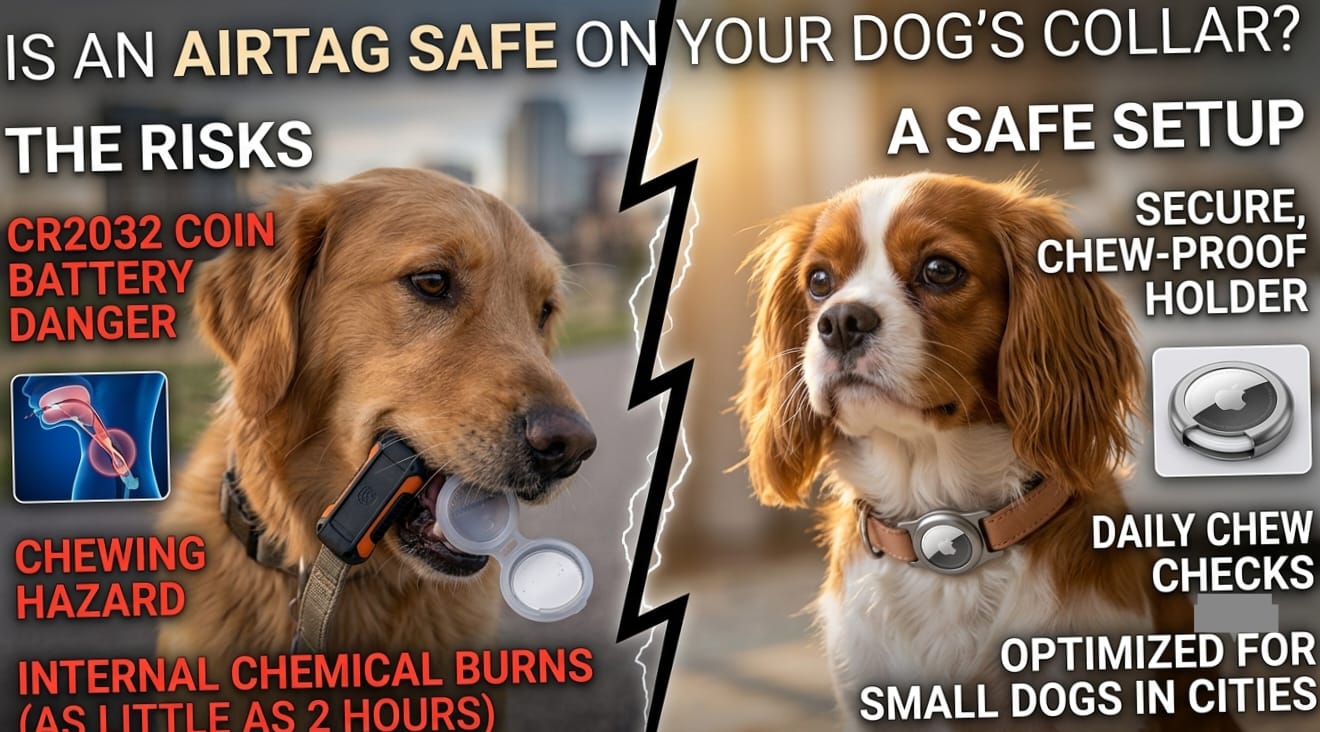
Is it safe to put an AirTag on a dog’s collar?
With caution. AirTags contain a CR2032 lithium coin cell battery that can cause severe internal chemical burns if swallowed. Apple’s own documentation warns that a swallowed battery can cause burns in as little as 2 hours. For dogs that chew their collar or accessories, an AirTag on a collar holder is a genuine safety risk. Use only in secure, chew-resistant holders and monitor regularly.
How far away can an AirTag track my dog?
The AirTag has a Bluetooth range of approximately 30 to 100 feet for direct connection to your phone. Beyond that range, it relies on other iPhones passing near your dog. There is no guaranteed range — in rural areas, an AirTag may not update for hours or may never update if no iPhones come near your dog.
What GPS tracker is best for a dog that runs away?
For most pet owners in suburban and rural settings, the Tractive GPS Dog Tracker offers the best combination of reliable tracking, affordable subscription pricing, long battery life, and health monitoring features. For dogs in wilderness settings or hunting dogs, the Garmin Alpha system provides satellite-based tracking without cellular dependency.
Do I still need a microchip if my dog wears a GPS tracker?
Absolutely yes. A GPS tracker requires battery power, can fall off, and can malfunction. A microchip is a permanent, passive ID that requires no battery and cannot fall off. Shelters and vets scan for microchips as standard procedure when any stray animal is brought in. A microchip is what brings your dog home if the GPS tracker fails — and the combination of both dramatically increases your chances of reunion.
Does the AirTag work for Android users?
No. AirTag works exclusively with Apple’s Find My network, which requires iPhones. Android users cannot use AirTag as a pet tracker. Android users should choose a dedicated GPS tracker like Tractive, which works with both iOS and Android apps.
Will an AirTag notify me if my dog leaves my yard?
You may receive a “left home” notification when your AirTag moves away from your home network, but this is passive and depends on the AirTag connecting to another Apple device. Unlike a GPS tracker’s geofence alert — which is instant, precise, and triggered the moment your dog crosses a set boundary — the AirTag notification is unreliable and delayed.
Is a GPS tracker worth the monthly subscription cost?
For any dog that has ever escaped, belongs to an escape-prone breed, or lives in a property with non-secure boundaries, yes. The monthly cost of a GPS tracker ($5–$8) is less than a cup of coffee per week. The cost of a lost dog — emotionally and financially — is orders of magnitude higher.
The Honest Verdict: Which Is Safer for a Dog That Runs Away?
There is no ambiguity here. For a dog that runs away, a GPS tracker is safer and more effective than an Apple AirTag in nearly every scenario.
The AirTag was built for lost wallets. Your running dog is not a wallet. A dog that bolts may cover miles in minutes, in any direction, in areas that may have no iPhone users nearby. In that scenario, the AirTag provides nothing — and if your dog chews it off their collar and swallows it, the AirTag creates an active medical emergency.
A GPS tracker was built for exactly this situation. The moment your dog leaves your defined zone, you know. You open an app. You see a moving dot on a map. You go get your dog.
The AirTag has one real advantage: cost. If budget is a genuine constraint, an AirTag in a chew-resistant holder provides some protection in urban environments and as a microchip backup — but it should never be your primary or only tracking solution.
The microchip remains the non-negotiable foundation of every dog safety plan. It does not track, but it identifies. When a shelter scans your dog three days after they went missing and the GPS tracker battery has long died, the microchip is what brings your dog home.
The recommendation:
- Microchip your dog and keep registration current — non-negotiable
- GPS tracker for real-time recovery — essential for escape-prone breeds and non-urban environments
- AirTag as a backup layer — optional, useful in iPhone-dense cities
Already Have Your Tracking Device? Make Sure You Also Have a Recovery Plan.
Even with a GPS tracker on your dog’s collar, there are scenarios where technology fails: dead batteries, cellular dead zones, or a collar that comes off during an escape. When that happens, your next layer of protection is your microchip — and your recovery plan.
Read these next:
How to Find a Lost Dog With a Microchip — The Exact Recovery Process (internal link — Article 7)
👉 Reasons Why Dogs Run Away From Home — And How to Prevent It (internal link)
👉 How to Register Your Dog’s Microchip — Complete Step-by-Step Guide (internal link)
