
What Is a Pet Microchip?
How Does Pet Microchipping Work?
How Much Does Microchipping Cost?
Does Microchipping Hurt Your Pet?
How to Register Your Pet’s Microchip
How Shelters Use Microchips to Reunite Pets
Microchip vs. GPS Tracker: What’s the Difference?
Common Microchipping Myths — Debunked
Where to Get Your Pet Microchipped
What to Do After Your Pet Is Microchipped
Frequently Asked Questions
What Is a Pet Microchip?
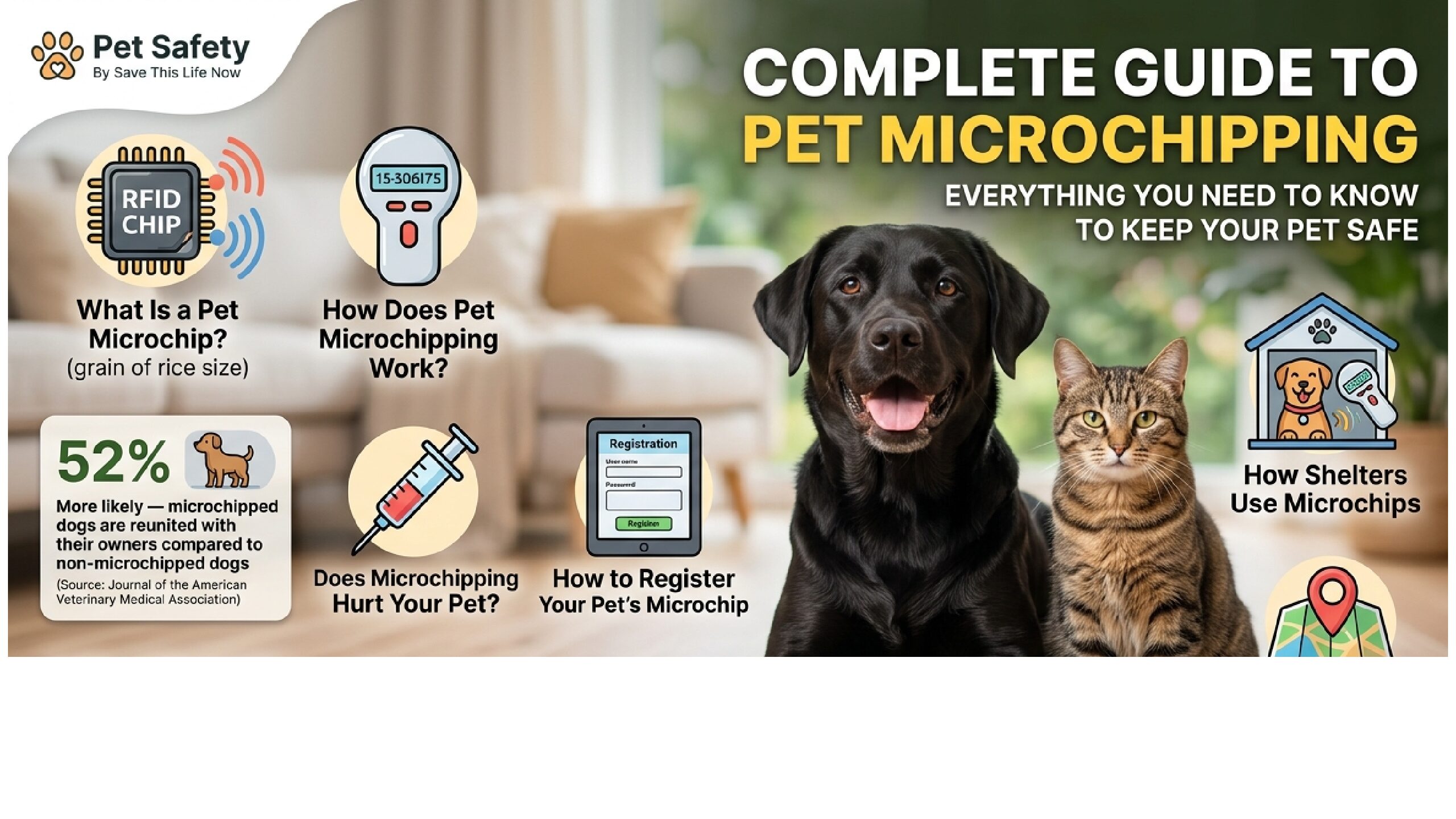
A pet microchip is a tiny passive radio-frequency identification (RFID) device roughly the size of a grain of rice implanted under your pet’s skin. It contains a unique identification number (typically 15 digits) that can be scanned and looked up in a database to find your contact information.
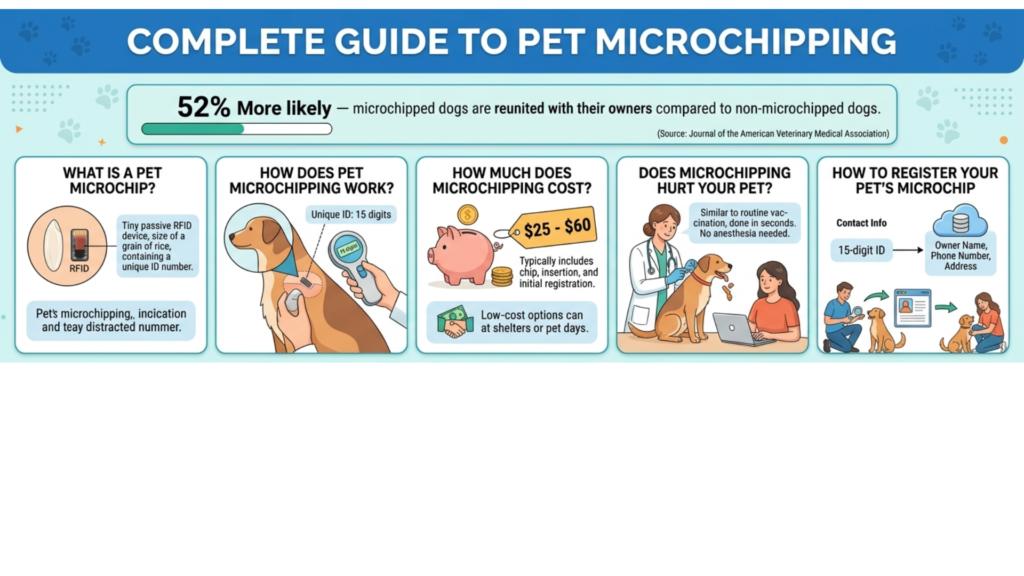
Microchips are not GPS trackers. They do not require a battery, they cannot track your pet’s location in real time, and they never need charging or maintenance. Instead, they serve as a permanent, unforgeable form of ID like a social security number for your pet that lives just beneath the skin.
How Pet Microchipping Works
Microchips use passive RFID technology. They contain no battery and produce no signal on their own. When a vet or shelter worker holds a microchip scanner near the implant site, the scanner emits a low-frequency radio wave that powers the chip for a split second just long enough to transmit the ID number. That number is then looked up in a pet registry database.
What Information Is Stored on a Microchip?
The chip itself stores only one thing: a unique identification number. That’s it. All of your personal information your name, address, and phone number is stored in the pet registry database linked to that number. This means:
Your personal data is not on the chip it stays private in the registry
You can update your contact information anytime without replacing the chip
If your pet is found and scanned, the finder sees only the ID number then looks up your details in the database
How Does Pet Microchipping Work?
The microchipping process is fast, simple, and requires no surgery. Here is exactly what happens from start to finish:
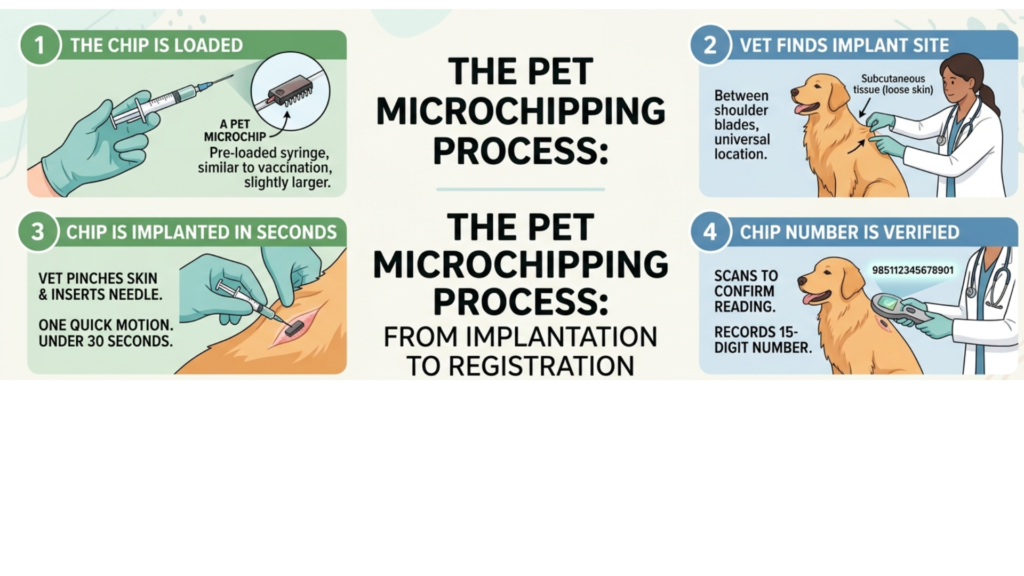
The chip is loaded into a needle
The microchip comes pre-loaded in a sterile, single-use syringe similar in size to those used for standard vaccinations, just slightly larger.
The vet finds the implant site
For dogs and cats, the standard location is between the shoulder blades in the subcutaneous tissue (the loose skin layer beneath the outer skin). This is the universal location so scanners know exactly where to check.
The chip is implanted in seconds
The vet pinches the skin and inserts the needle. The chip is deposited in one quick motion. The whole procedure takes under 30 seconds.
The chip number is verified
The vet immediately scans the implant site to confirm the chip is reading correctly and records the 15-digit number in your pet’s file.
You register the chip online
You take the chip number home and register it in a pet microchip database with your contact information. This step is critical — without registration, a found chip leads nowhere.
The #1 Reason Microchips Fail to Reunite Pets
In a 2021 study, over 35% of microchipped pets that arrived at shelters were not registered in any database. The chip was there but with no owner information attached, it was useless. Implanting the chip is only half the job. Registration is what actually brings your pet home.
How Much Does Pet Microchipping Cost?
Microchipping is one of the most affordable permanent safety measures you can give your pet. Here’s a breakdown of what you can expect to pay:
$25–$75
At a private vet clinic (most common)
$10–$25
At a humane society or animal shelter
$0–$15
At free/low-cost community microchip events
$0–$19/yr
Annual registry fee (varies by service)
How to Find Free or Low-Cost Microchipping
Local animal shelters Many offer microchipping at a reduced rate or even free for adopted pets
Petco Love Hosts regular microchip clinics at store locations across the US
ASPCA events Check your local ASPCA chapter for free microchipping days
Rescue organizations Most microchip all animals before adoption
Vet schools Veterinary school clinics often offer services at lower rates
Search “free pet microchipping near me” Local events are common, especially in spring and fall
Pro Tip: Bundle It With Your Annual Vet Visit
Many vets offer microchipping as an add-on during routine wellness visits, sometimes at a discount. If your pet hasn’t been chipped yet, ask at your next appointment. The whole thing adds less than 5 minutes to the visit.
Does Microchipping Hurt Your Pet?
This is the question most pet owners ask and the honest answer is: probably not, or very briefly.
The needle used for microchipping is slightly larger than a standard vaccine needle. Most dogs and cats react the same way they do to a routine shot — a momentary flinch, and then nothing. Veterinarians commonly report that pets are more stressed by being held still than by the implant itself.
Does My Pet Need Anesthesia?
No. Microchipping does not require anesthesia or sedation under normal circumstances. However, if your pet is already being anesthetized for another procedure (such as a spay or neuter), vets often recommend chipping at the same time it’s a convenient opportunity with no additional pain at all.
Is There Any Risk?
Microchipping is considered extremely safe. Rare complications can include:
Chip migration — The chip may shift slightly from the original implant location over time. This is harmless, but means the scanner needs to cover a broader area when searching.
Minor swelling or tenderness Typically resolves within 24–48 hours
Infection Extremely rare, especially when implanted by a licensed professional
What About Cats?
Cats tend to be more sensitive than dogs, but the procedure is equally safe and just as quick. Many cat owners report their cat didn’t react at all. The implant site and process are identical to dogs.
How to Register Your Pet’s Microchip (Step-by-Step)
Getting the chip implanted is only the first step. Registering your chip is what actually makes it useful. Without registration, a shelter worker who finds your pet will scan the chip, see a number, search the database, and find nothing because you never linked your information to that number.
Here is how to register correctly:
Get your chip number from your vet
Your vet should give you a document or sticker with the 15-digit chip number after the procedure. If you lost it, ask your vet to scan your pet and read you the number.
Choose a pet microchip registry
There are several registries in the US (see the comparison below). We recommend registering in at least two: one free universal lookup database and one that your vet recommends.
Create an account and enter the chip number
Go to the registry’s website, create an account, and link your chip number to your current contact information — name, address, phone number, and a secondary emergency contact.
Add your pet’s photo
Many registries allow a pet photo. Add one it makes identification faster and more reliable in a reunion scenario.
Update your information whenever you move or change your number
A chip linked to an old phone number or address is nearly as useless as an unregistered chip. Set a calendar reminder to verify your registry details every year.
Best Pet Microchip Registries in the USA
AAHA Universal Pet Microchip Lookup
lookup.aaha.org The official universal lookup tool used by shelters and vets across the US. Not a registry itself, but searches all major databases at once. Always check your chip here.
Free
Found Animals Registry
foundanimals.org Free, lifetime registration. No annual fee. One of the most recommended free registries.
Free
PetLink
petlink.net Free basic registration, with optional paid plans for lost pet alerts. Used by many shelters and included with some chip brands.
Free
AKC Reunite
akcreunite.org — The American Kennel Club’s registry. Small one-time or annual fee. Includes 24/7 lost pet support hotline and proactive lost pet recovery assistance.
From $17.50
Home Again
homeagain.com Paid registry with additional services: lost pet alerts, 24/7 hotline, travel assistance. Popular and widely recognized by shelters.
~$19.99/yr
Register in Multiple Databases by pet microchipping
The US does not have a single national pet microchip registry. Different shelters and vets check different databases. Your safest bet is to register in at least two registries one free (like Found Animals) and one checked by your local shelter. Ask your vet which database they use.
How Shelters Use Microchips to Reunite Pets
Understanding this process is crucial because knowing what happens on the other end motivates you to register properly.
When a stray animal arrives at a shelter, the very first thing staff do is scan for a microchip. This happens before the animal is photographed, vaccinated, or assigned a kennel number. Most shelters use a universal scanner that detects chips from all major manufacturers.
If a chip is detected:
The 15-digit number is recorded
Staff check the AAHA Universal Pet Microchip Lookup at lookup.aaha.org this tool searches multiple databases simultaneously
If a match is found, the shelter contacts the registered owner immediately
If no match is found (unregistered chip), the animal enters the shelter system as a stray
Time Is Critical in Shelters
Many shelters have holding periods of just 72 hours for stray animals before they become available for adoption or, in underfunded facilities, face euthanasia. A registered microchip can trigger a reunion call within hours of a pet arriving at a shelter long before the holding period ends.
Microchip vs. GPS Tracker: What’s the Difference?
These two technologies are often confused but they serve completely different purposes. You don’t have to choose: the best-protected pets have both.
Feature Microchip GPS Tracker
How it works Passive RFID scanned by a reader at short range Active GPS satellite tracking real-time location via app
Battery required No lasts lifetime Yes needs regular charging
Can it be lost or removed No implanted permanently Yes collar/attachment can fall off
Real-time location No Yes track your pet right now
Cost $25–$75 one-time $30–$150 device + $5–$15/mo subscription
Works without smartphone Yes any scanner, anywhere Usually requires app and cell coverage
Best for Permanent ID, reuniting with shelters Active tracking, preventing loss
Our recommendation: Microchip your pet as a permanent baseline. Consider a GPS collar as a supplementary tool if your pet is an escape artist or spends time outdoors unsupervised. The microchip works even if the GPS collar runs out of battery or falls off.
Common Pet Microchipping Myths Debunked
Myth
“My pet has a collar and tag — that’s enough.”https://killarneyanimalhospital.com/microchipping-myths-debunked-is-your-pet-truly-safe/#:~:text=Myth%201%3A%20Microchips%20Can%20Track,for%20real%2Dtime%20location%20monitoring.
Fact
Collars break, slip off, and tags fade. In one study, over 50% of lost pets were found without their collar. A microchip can never fall off or be removed.
Myth
“Microchips track my pet’s location like GPS.”
Fact
Microchips are passive RFID devices with no GPS capability. They cannot track location — they only store an ID number that requires a scanner to read.
Myth
“Microchipping causes cancer in pets.”
Fact
A handful of very rare tumor cases near implant sites have been reported, but no scientific study has established a causal link. Major veterinary organizations worldwide consider microchipping safe.
Myth
“Once chipped, my pet will always be found.”
Fact
Only if your chip is registered with current contact information. An unregistered chip or one with an old phone number is functionally useless.
Myth
“Microchips are only for dogs.”
Fact
Microchips can be implanted in cats, rabbits, birds, horses, ferrets, and even reptiles. The process and chip are the same.
Myth
“Indoor pets don’t need microchips.”
Fact
Indoor pets escape through open doors, windows, and during emergencies like fires or floods. They are actually harder to find because they have no outdoor experience and travel less predictably.
Where to Get Your Pet Microchipped
You have several options depending on your budget and location:
Your regular veterinarian The most common option. Book a routine appointment and ask for microchipping as an add-on. Cost: $25–$75.
Local animal shelters Most offer microchipping at a reduced cost to the public, not just adopted animals. Call ahead to confirm.
Petco and PetSmart in-store clinics Both chains host regular low-cost veterinary clinics where microchipping is offered. Check store websites for dates.
Mobile vet services Many mobile veterinarians offer microchipping as part of their service menu, which is convenient if your pet is difficult to transport.
Community microchip events Organizations like the ASPCA, Humane Society, and local rescues hold free or low-cost microchipping events throughout the year. Search online for events in your area.
What to Do After Your Pet Is Microchipped
The implant is just the beginning. Follow this checklist to make sure the chip can actually do its job:
Get the 15-digit chip number in writing from your vet store it somewhere safe
Register the chip number in at least two pet microchip databases within 24 hours
Verify registration by searching your chip number at lookup.aaha.org
Add your pet’s photo to the registry profile
Add a secondary emergency contact (family member or neighbor) to the registry
Update your information in the registry any time your phone number, address, or emergency contact changes
Ask your vet to scan the chip at every annual wellness visit to confirm it’s still reading correctly
Keep a collar and ID tag on your pet as a first line of identification
Set an annual calendar reminder to verify your registry contact details
Is Your Pet Already Microchipped?
Look up your chip number right now to make sure your registration is current and complete.
Check Your Chip at AAHA → Register for Free →
Frequently Asked Questions About Pet Microchipping
These are the most common questions pet owners ask about microchipping — answered clearly and completely.
How much does it cost to microchip a dog?
+
Microchipping a dog typically costs between $25 and $75 at a veterinary clinic. Many animal shelters offer it for $10–$25, and community microchip events often provide it for free or as low as $10. Once implanted, the chip itself requires no further cost — though some pet registries charge an annual fee of $10–$20.
Does microchipping a dog or cat hurt?
+
How do I find out if my pet is already microchipped?
+
Can a vet or shelter scan any microchip brand?
+
How long does a pet microchip last?
+
What if my contact information changes after microchipping?
+
Are microchips required by law?
+
Can a microchip fall out or move inside my pet?
+
Can a microchip track my pet’s location?
+
Final Thoughts: Microchip Your Pet Today
A pet microchip is a one-time, 30-second procedure that can make the difference between a lost pet and a lost pet forever. It is the single most reliable permanent identification tool available — and it costs less than a dinner out.
But the chip alone does nothing. The real power is in registration. If you’ve already had your pet microchipped, take five minutes right now to verify that your registration is current and searchable at lookup.aaha.org. If you haven’t microchipped yet — call your vet today.
Your pet trusts you with their life. This is one of the easiest ways to honor that trust.
Take Action Right Now by installing Pet Microchipping
Don’t wait until your pet goes missing. These two steps take less than 10 minutes and could save their life.
Verify Your Chip Registration → Register Your Chip Free →https://savethislifenow.com/category/pet-microchip-guides/
Related Articles on Save This Life Now
How to Register a Pet Microchip (Step-by-Step Guide)
My Dog Is Missing: What to Do in the First 24 Hours
Microchipping Cats: Complete Guide for Cat Owners
Microchip vs. GPS Tracker: Whichhttps://savethislifenow.com/lost-dog-without-collar-or-tags/ Does Your Pet Need?
Best Pet Microchip Registries in the USA
